Introducing Total Return Swap (TRS): Perps, Built Differently
Flying Tulip is deploying a sequence of integrated financial products that share the same pricing, collateral and settlement infrastructure. Rather than forcing users to move assets between separate lending markets, trading venues and aggregators, each part of the stack is designed to work with the others, reducing transactions, wrappers, fee hops and accounting complexity.
Because Flying Tulip is built as one connected stack, capital can remain productive across multiple functions. Deposits earn yield, provide borrowing power and support spot execution, margin positions and derivatives without users having to withdraw and redeploy assets between disconnected protocols.
This reflects the core idea behind Flying Tulip’s approach to onchain finance: combine direct control of assets, transparent rules and open participation with the functionality and capital efficiency associated with centralized financial venues. The objective is not to recreate the original model of fully decentralized finance or replace traditional finance, but to offer the best of both worlds.
Enter TRS: Live on Ethereum and Sonic
Coordinating lending, execution and settlement within one account system makes it possible for Flying Tulip to offer products that are otherwise difficult to reproduce efficiently across fragmented DeFi protocols.
Lend provides the margin and borrowing layer, Trade provides spot execution and price discovery, and ftUSD provides the settlement rail. Together, they support leveraged and synthetic positions without requiring a separate collateral, execution and settlement stack for every product.
Total Return Swap (TRS) is a financial contract that gives users the economic return of a reference asset without requiring ownership. Widely used by hedge funds, credit funds and other institutions in traditional finance, Flying Tulip’s integrated infrastructure makes it possible to finally bring this structure onchain.
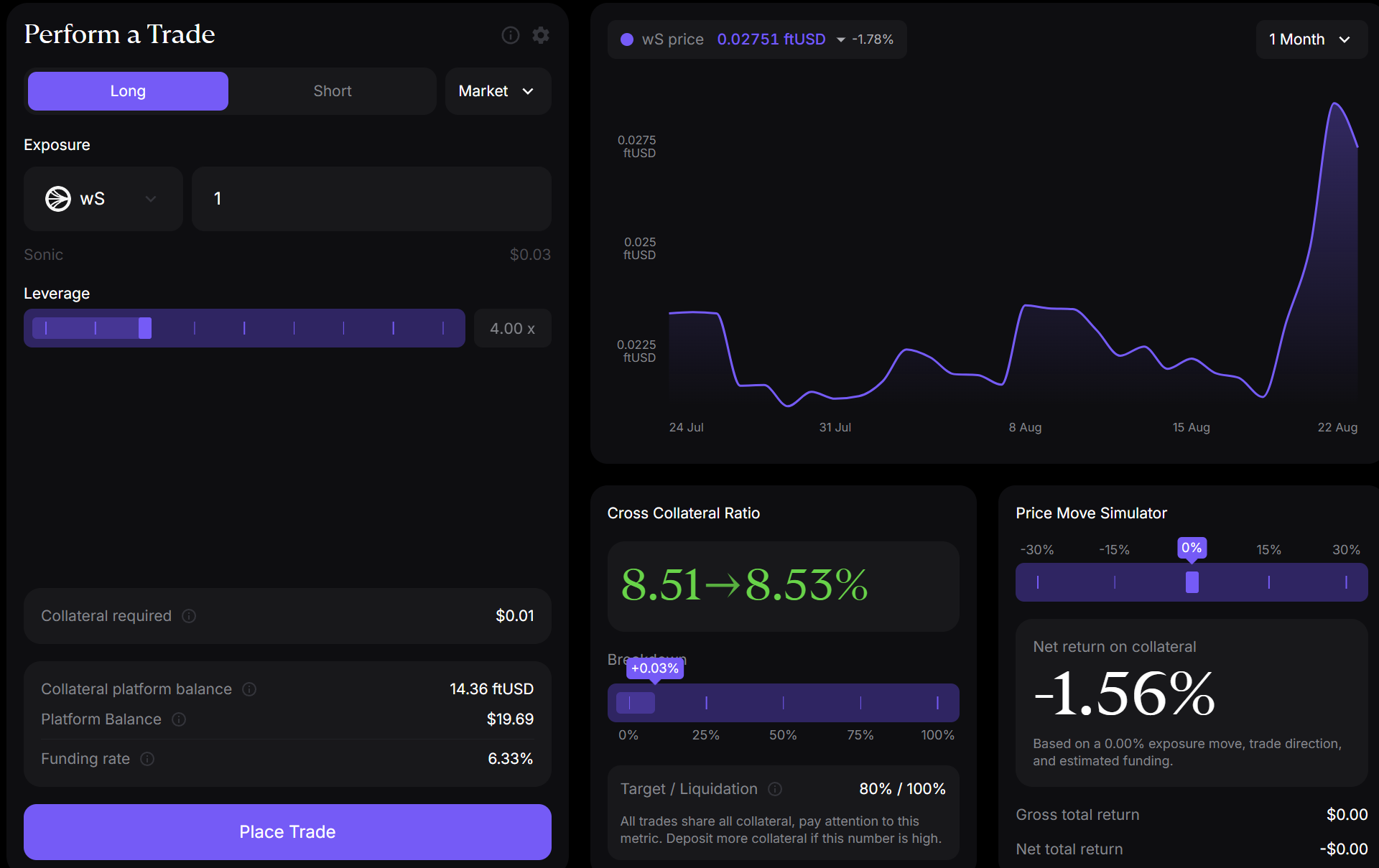
With Flying Tulip TRS, users choose a supported underlying asset, go long or short, select collateral and set leverage within the limits shown by the interface. Flying Tulip automatically calculates the required margin and displays financing costs and account-health requirements. P&L reflects the direction of the position and price movements in the underlying asset, adjusted for financing costs and fees.
TRS Compared With Perpetuals
The main difference between Flying Tulip TRS and conventional perps is the financing model. Perpetual markets use recurring funding payments to help keep the contract price aligned with spot. Flying Tulip TRS financing is instead based on collateral yield and the actual cost of borrowing the assets used to construct the position.
This makes financing materially cheaper than a comparable perp.
Unlike perps, Flying Tulip TRS has no orderbook fees and uses RFQ (Request for Quote) for execution. Conventional perps are limited to the liquidity available in their own orderbook and typically charge taker fees. Flying Tulip TRS can instead source execution across available onchain liquidity, comparing venues to find the best executable price. The difference is similar to swapping against a single DEX pool versus using an aggregator across the chain.
Risk is assessed at the account level rather than through a simple loan-to-value ratio (LTV). Flying Tulip evaluates account equity and maintenance requirements, closer to the margin-account model used by centralized exchanges. This allows collateral, debt, profit and loss, and related positions to be evaluated together.
TRS is also designed without auto-deleveraging (ADL). Because the exposure is constructed through Flying Tulip's Lend and Trade, a position can remain open as long as the account continues to meet its margin requirements.
If account equity falls below the required maintenance level, part or all of the position can still be liquidated. When an account requires liquidation, Flying Tulip issues an RFQ and uses the best available bid to sell only what is needed to repay debt and restore account health. This is designed to improve execution and reduce unnecessary losses compared with mechanisms that automatically transfer collateral at a predetermined discount.
TRS, Built Differently
In summary, Flying Tulip TRS provides perp-like exposure to supported assets without requiring direct ownership of the underlying asset. It is built on Flying Tulip’s integrated infrastructure, with Lend providing financing, Trade providing execution and ftUSD providing settlement.
Flying Tulip TRS offers:
▸ Leveraged long or short exposure to supported assets
▸ Capital efficiency and leverage comparable to perps
▸ Cheaper financing based on Lend borrowing costs and collateral yield
▸ P&L reflecting price movements in the underlying asset
▸ Execution against spot liquidity
▸ Settlement in ftUSD
▸ No auto-deleveraging, subject to margin and liquidation requirements
Feedback and issue reports are welcome through Discord.
Socials
- Website: https://flyingtulip.com
- X/Twitter: https://x.com/flyingtulip_
- Discord: https://discord.gg/flyingtulip
- Telegram Chat: https://t.me/flyingtulipgroup
- Telegram Announcements: https://t.me/flyingtulipann
Products