Introducing Trade: Flying Tulip's trading engine and price source

Flying Tulip is designed as a single entry point for onchain finance. Users can already deposit supported assets into a Lend margin account to earn interest and borrow against their collateral, or mint and stake ftUSD to earn yield.
Trade is now live on Ethereum, Sonic, and BNB Smart Chain, extending the same account to Spot and leveraged spot. Users can swap supported assets, place market or limit orders, and open leveraged long or short positions using the same collateral.
Within Flying Tulip, the same capital can remain productive across lending and trading instead of being fragmented across separate venues. Because Trade is integrated with Lend, assets remain in the margin account and continue earning yield even while an order is pending.
The objective is simple: make your capital do more.
By providing access to a suite of products with standardized pricing, credit, and risk, Flying Tulip aims to restore composability within a single system, increasing capital efficiency while providing users with direct control of their assets, transparent rules and open participation.
Each new product adds another layer to the Flying Tulip stack and increases the utility of products already live. ftUSD provides liquidity and settlement; Lend provides the account-based collateral, borrowing and margin layer; Trade provides execution. Future products extend the same infrastructure into synthetic exposure, derivatives and insurance.
Activity across the system generates fees that flow back to FT through open-market buybacks.
What is available through Trade
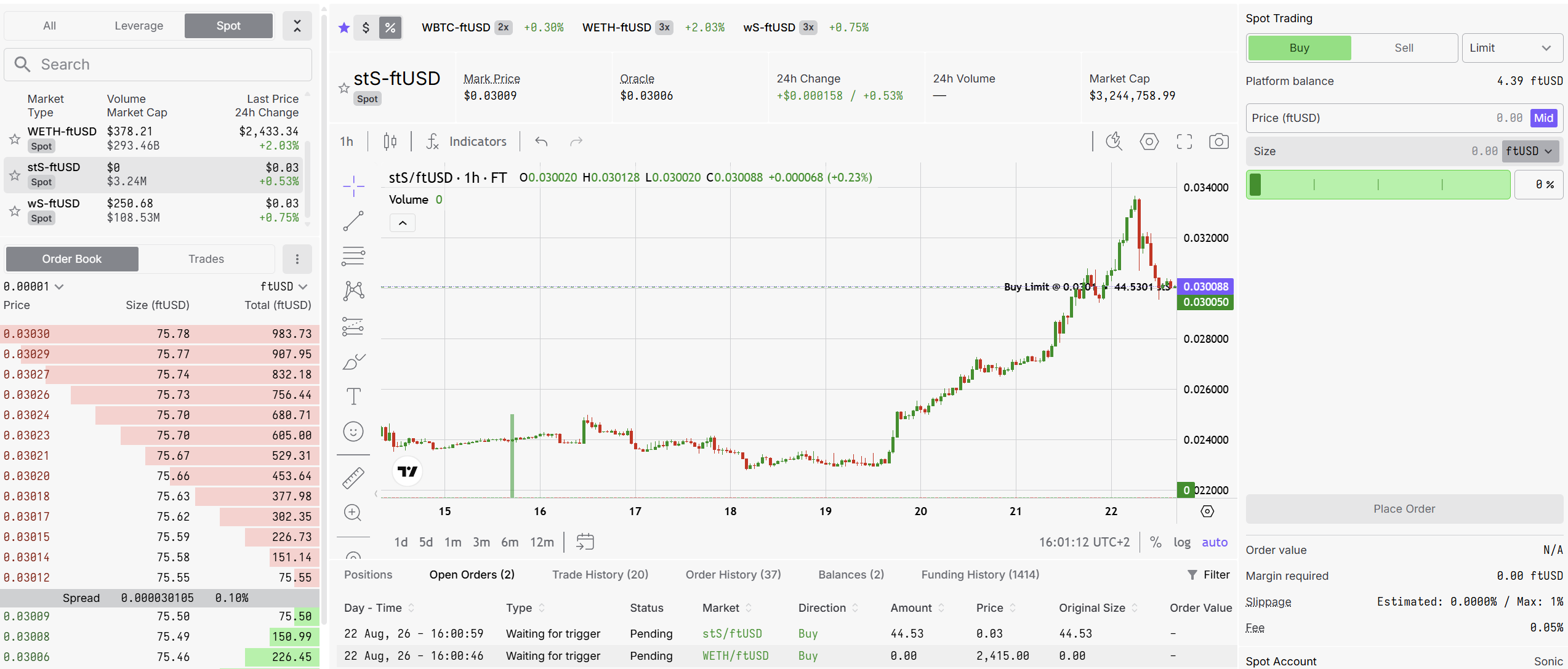
Spot
Spot lets users buy or sell supported assets without borrowing or taking on leverage. Users select a market, choose a market or limit order, enter the trade size and, for limit orders, set the desired price. Before confirming, the interface shows the estimated execution, fees and slippage.
Spot can support a broader set of tradeable assets with executable liquidity, while leverage is limited to assets enabled in Lend that can safely be borrowed or used as collateral in the margin system.
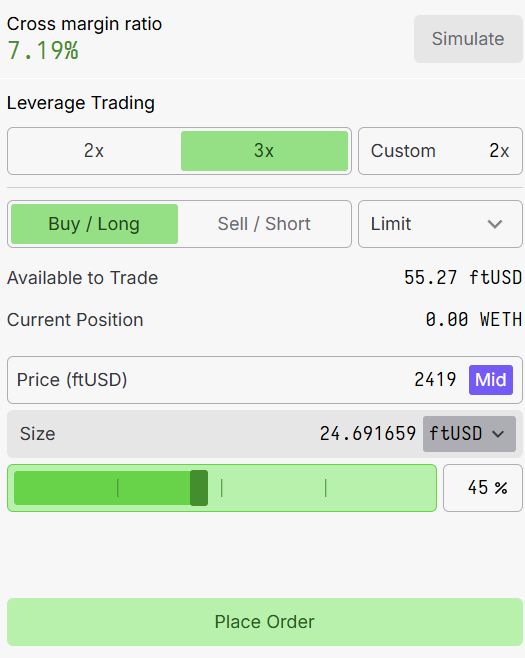
Leveraged spot
Leveraged spot allows users to take exposure greater than the collateral they initially provide.
Users choose the asset they want exposure to, select collateral, decide whether to go long or short, and adjust leverage within the limits shown by the interface. Flying Tulip then calculates the required margin and displays the estimated borrowing cost, fees, slippage and account-health requirements.
Unlike a perpetual future or another purely synthetic position, leveraged Spot is constructed through actual borrowing in Lend and execution through Spot.
To open a leveraged long position, the system:
- uses the user’s collateral in the Lend margin account;
- borrows the asset the user is effectively shorting;
- routes that borrowed asset through RFQ (Request for Quote)/swap execution;
- acquires the asset the user wants to be long;
- deposits the acquired asset back into the account as collateral.
Closing the position reverses the process: the long asset is withdrawn and sold into the debt asset, and the outstanding borrow is repaid.
For example, opening a leveraged long position in WETH using stablecoin collateral involves borrowing the stablecoin, exchanging it for WETH and holding the WETH inside the account. The user gains leveraged WETH exposure while carrying the corresponding stablecoin debt. To close the position, the system sells enough WETH back into the debt asset to repay the outstanding borrow, leaving any remaining proceeds in the user’s account.
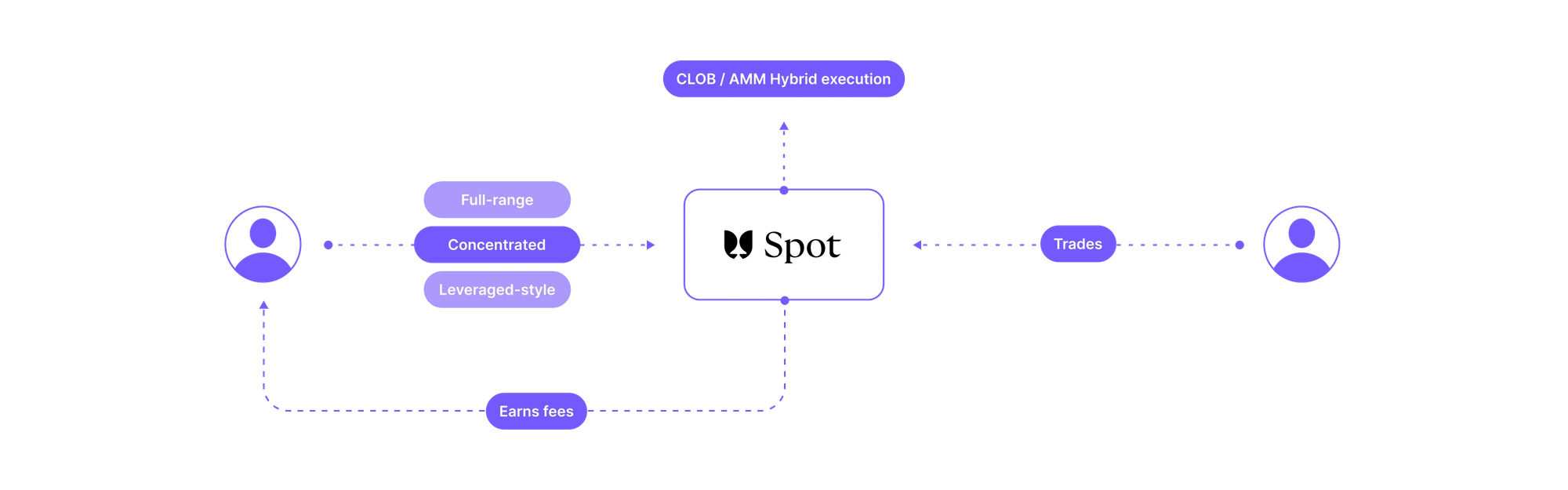
The broader Trade architecture
The current Trade release provides spot and leveraged spot, including market and limit orders for supported pairs. As additional components complete testing and security review, they will be activated progressively and integrated into the Trade architecture.
In addition to the AMM, a fully onchain CLOB (central limit order book) is currently being hardened. The AMM provides continuous liquidity, while the CLOB provides limit‑order precision. Once the CLOB launches, trades will clear on the AMM, through the CLOB, or across both; whichever produces the best executable price for the order size.
The broader roadmap extends Trade into a permissionless trading stack with market-driven asset discovery, a volatility-adaptive AMM and permissionless lending markets derived from the liquidity of each trading pair. As the trading stack matures, depth‑aware internal pricing extends to a wider set of markets including permissionless futures and options.
Feedback and issue reports are welcome through Discord.
Socials
- Website: https://flyingtulip.com
- X/Twitter: https://x.com/flyingtulip_
- Discord: https://discord.gg/flyingtulip
- Telegram Chat: https://t.me/flyingtulipgroup
- Telegram Announcement: https://t.me/flyingtulipann
Products
- PUT Marketplace: https://marketplace.flyingtulip.com
- ftPUT: https://flyingtulip.com/allocation/dashboard
- ftUSD: https://flyingtulip.com/ftusd/dashboard
- Lend: https://flyingtulip.com/lend/dashboard
- Trade: https://flyingtulip.com/trade
- Product Suite Documentation: https://docs.flyingtulip.com/product-suite