Flying Tulip September Update

It’s been a big month for Flying Tulip! We launched Trade, Total Return Swap (TRS) and Rewards, introduced automatic compounding for ftUSD through ssftUSD, and rolled out our product suite on BNB Chain. Lending capacity increased, asset support expanded, and users gained additional ways to mint ftUSD.
September brought us much closer to what we set out to build: a connected set of products that work together in one account. ftUSD provides liquidity and settlement; Lend supplies the collateral, credit and margin infrastructure; Trade adds execution; and TRS extends the same foundation into synthetic exposure.
Your capital can now do more, with each product increasing the usefulness of the others. For example, capital deposited to Lend can earn yield while providing borrowing power and supporting positions within the same account.
Andre and Anton’s August interviews explain why we designed the products this way. Users should be able to access the capital efficiency of a modern financial venue while retaining direct control of their assets, with clear rules and visibility into onchain activity.
We're optimizing Flying Tulip around best execution for users: good clearing prices, deep liquidity, efficient liquidations, and minimizing value leakage during execution. - Andre Cronje
Flying Tulip's expansion happens in two directions: by bringing the products to additional chains, and by making each deployment more useful through additional products and deeper liquidity. September advanced both.
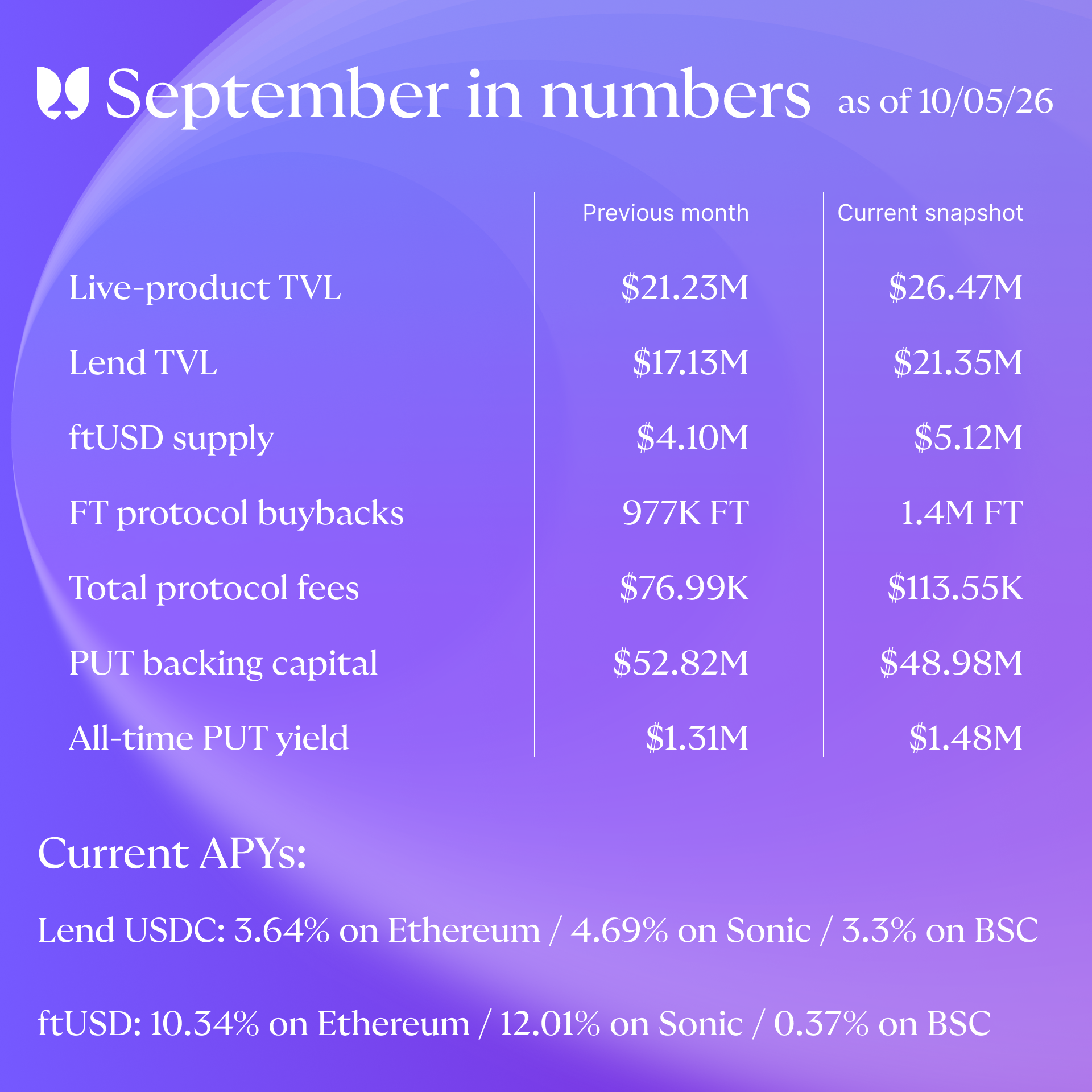
Existing products also continued to grow. As of October 5, live-product TVL was at $26.47 million, with Lend TVL at $21.35 million, compared with $17.13 million at the end of August. ftUSD supply reached $5.12 million, up from $4.10 million. Separately, September saw an additional burn of unallocated, non-circulating FT from the PUT reserve.
1. Trade: trading engine and price source
Trade launched on September 1 on Ethereum and Sonic, and later on BNB Smart Chain, adding spot and leveraged spot trading to Flying Tulip’s existing account infrastructure. Users can swap supported assets, place market or limit orders, and take leveraged long or short positions.
 Newton
Because Trade works directly with Lend, eligible assets remain productive while an order is pending. Users can place an order without first withdrawing their collateral from the lending system.
Leveraged spot combines actual borrowing with spot execution. A leveraged long, for example, borrows against the account’s collateral, exchanges the borrowed asset for the desired exposure, and deposits the purchased asset back into the margin account. Closing reverses that process and repays the debt.
The interface shows borrowing costs, execution estimates and account-health requirements before confirmation.
Trade is now live on Sonic, and it is more than a place to swap.
— flyingtulip.com (@flyingtulip_) September 2, 2026
It is Flying Tulip’s trading engine and price source, providing execution for the same account used to lend, borrow and manage collateral.
Here is how it works👇
Trade walkthrough (with clips).
Sessions make trading smoother by removing the need to confirm every action in your wallet. You approve a session once, choosing the permissions, spending limits and expiry, then trade within those limits without signing each transaction separately. The session stays active until it expires, reaches its limits or you revoke it, which you can do at any time.
Development of the broader execution stack continued, with the fully onchain central limit order book undergoing testing and hardening during September.
2. TRS: leveraged exposure through the connected stack
Total Return Swap (TRS) also launched on Ethereum, Sonic and BNB Smart Chain in September. TRS gives users long or short economic exposure to a supported asset without requiring direct ownership.
 Newton
For TRS, Lend provides financing, Trade provides execution, and ftUSD provides settlement.
TRS is materially cheaper than a comparable perp. Financing reflects collateral yield and the actual cost of borrowing the assets used to construct the position. I addition, execution uses requests for quotes (RFQ) across available onchain liquidity, with no order-book fees.
Risk is assessed across the account’s collateral, debt and profit or loss. TRS has no auto-deleveraging (ADL), and positions can remain open while their accounts meet margin requirements. Accounts that fall below maintenance requirements can still be liquidated, with RFQ execution used to sell the amount needed to repay debt and restore account health.
Total Return Swap (TRS) is now live on Flying Tulip, and it is more than another way to trade with leverage.
— flyingtulip.com (@flyingtulip_) September 4, 2026
TRS is an instrument institutions use to gain leveraged exposure to an asset without owning it, now built on the same infrastructure Flying Tulip already uses for… pic.twitter.com/OXV5uKJFjI
TRS walkthrough (with clips).
In summary, Flying Tulip TRS offers:
▸ Leveraged long or short exposure to supported assets
▸ Capital efficiency and leverage comparable to perps
▸ Cheaper financing based on Lend borrowing costs and collateral yield
▸ P&L reflecting price movements in the underlying asset
▸ Execution against spot liquidity
▸ Settlement in ftUSD
▸ No auto-deleveraging, subject to margin and liquidation requirements
TRS also has applications beyond directional trading. For example, a short position can offset the price exposure of a yield-bearing asset while allowing its holder to retain the staking return. The resulting carry depends on borrowing costs and other expenses.
Additional notes on hedging assets with TRS and the onchain advantage. It is worth noting that putting perpetual futures onchain does not automatically make them better instruments. Offchain perps are already highly optimized, and a synthetic contract still needs its own market liquidity rather than directly drawing on existing spot liquidity. However, for hedging, Flying Tulip’s TRS offers a stronger fit: it uses the connected lending and trading system, sources execution from available onchain liquidity, and bases financing on borrowing costs and collateral yield. Without auto-deleveraging, a hedge can remain open while the account meets its margin requirements, although it can still be liquidated if those requirements are breached.
The clearer onchain advantage is how much more useful the surrounding capital can become. Within Flying Tulip, eligible collateral can earn yield while supporting borrowing, pending spot orders, TRS and leveraged positions. Users can access those functions through the same account instead of moving capital between separate venues. That advantage comes from Flying Tulip’s shared collateral and integrated products; simply moving a conventional perp onchain does not create it.
Perps become more interesting when the positions themselves can be used across other products. Tokenized delta-neutral positions, leveraged exposure and oracle-linked exposure could become building blocks for other applications, including positions accepted as collateral. Pre-market perps offer another area to explore. This gives Flying Tulip room to differentiate itself from venues such as Hyperliquid by developing new uses for capital and trading positions, rather than relying on an inherent execution advantage from putting the same instrument onchain.
3. Flying Tulip arrives on BNB Chain
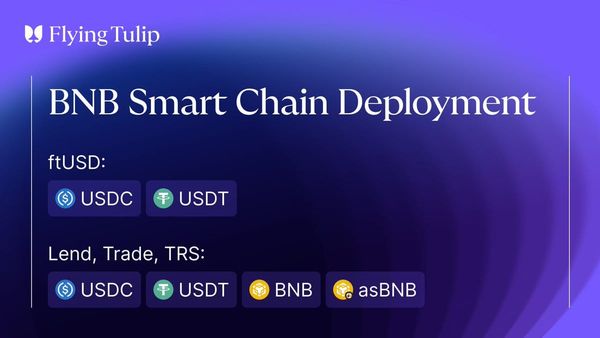
In September, Flying Tulip also launched ftUSD, Lend, Trade and TRS on BNB Chain. At launch, users could mint ftUSD with USDC or USDT. Lend supported USDC, USDT, BNB and asBNB, with supported assets available across the trading products.
 Newton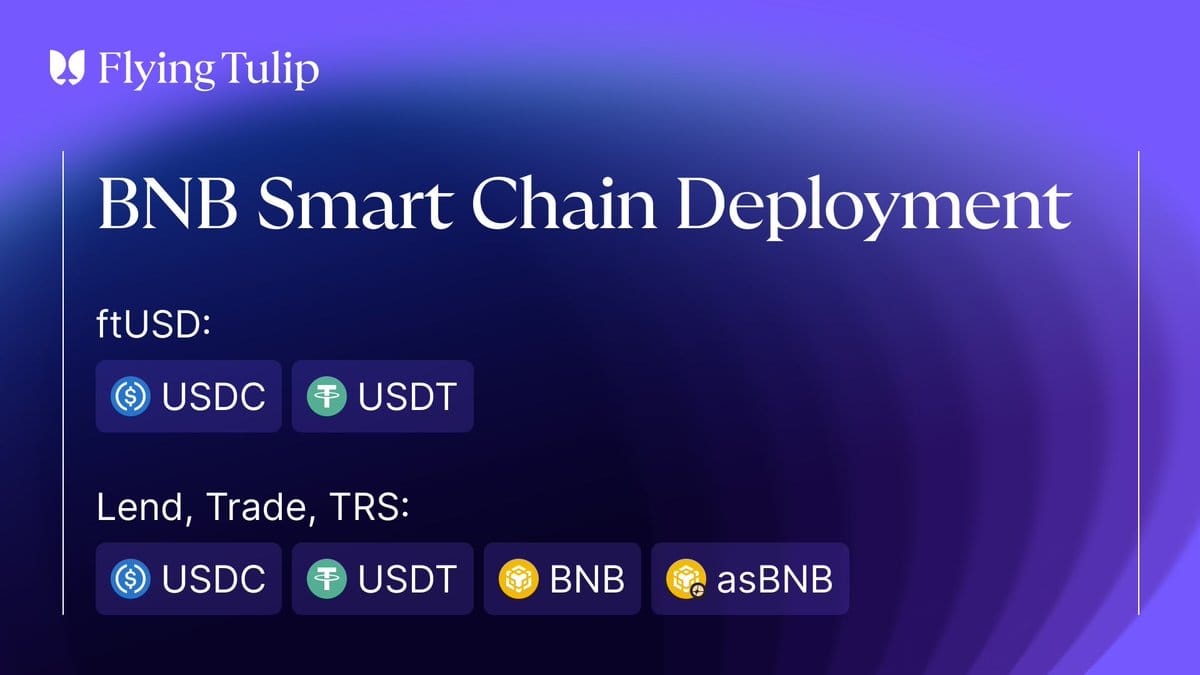
BNB Smart Chain is a natural next step for Flying Tulip. It has a large, active user base, deep onchain liquidity and an established ecosystem of stablecoins, lending and trading, which are the foundations our products need to grow. It also has a liquid staking token asBNB, which supports delta-neutral strategies that earn staking yield for ftUSD while hedging the underlying asset’s price exposure.
The deployment extends the connected-account approach to another ecosystem and its assets, users and liquidity. We plan to bring Flying Tulip to Monad and Robinhood next.
4. Higher caps and more assets on Lend, more ways to mint ftUSD
Asset support on Lend expanded across the final week of September, bringing more stablecoins, yield-bearing assets and tokenized ETF exposure into Flying Tulip.
Expanded asset support on Ethereum
The latest Ethereum Lend update covers:
- USDe and sUSDe from Ethena.
- crvUSD and scrvUSD from Curve.
- USDG from Paxos.
- wstETH from Lido.
Users can supply these assets to earn the applicable lending yield and use them as collateral to borrow. Yield-bearing assets such as sUSDe, scrvUSD and wstETH retain their underlying yield exposure while deposited. The same account provides access to Trade and TRS, allowing collateral and borrowing power to support trading and hedging across supported markets.
 Newton
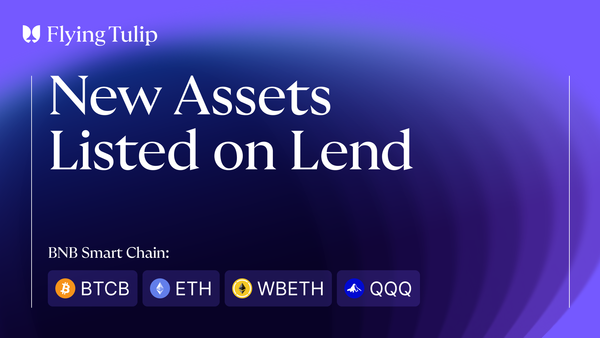
Four new assets on BNB Smart Chain
We also expanded BNB Smart Chain Lend with four additional listings:
- BTCB: Binance’s Bitcoin-pegged token, backed 1:1 with BTC.
- ETH: Binance’s fully collateralized, ETH-pegged token.
- WBETH: Wrapped Beacon ETH, representing staked ETH and accumulated staking rewards.
- QQQB: A tokenized bStock providing economic exposure to the Invesco QQQ Trust ETF.
 Newton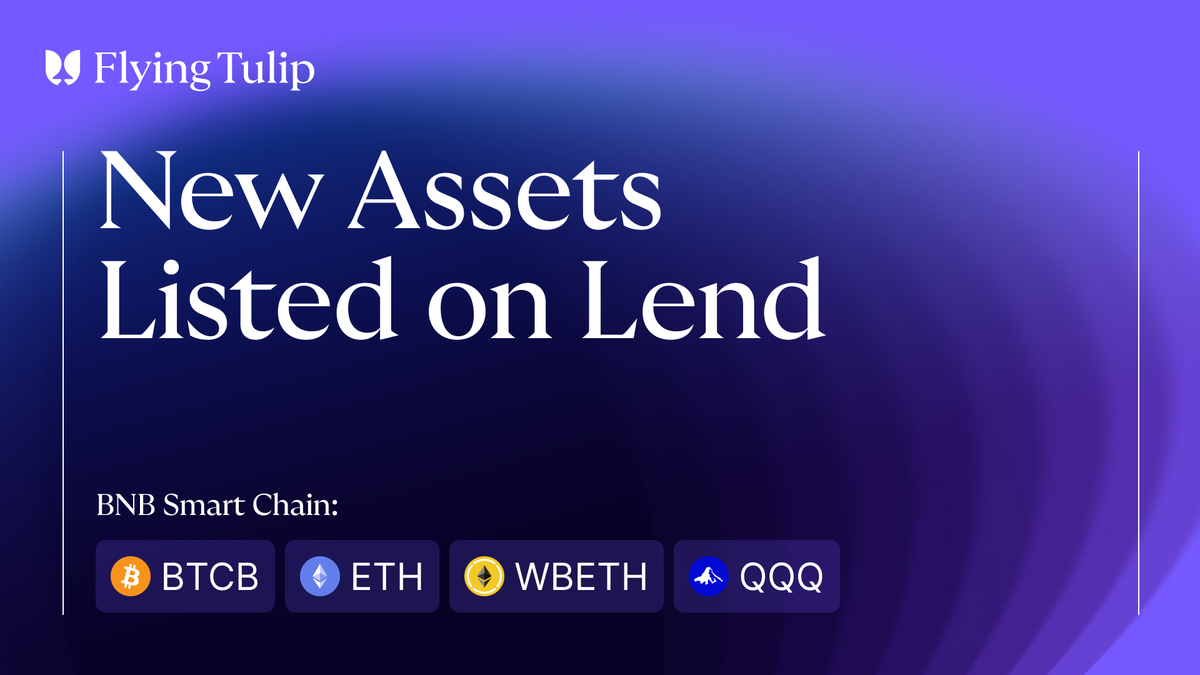
More capacity on Lend
In September, we increased several Lend caps, giving users more room to supply collateral, borrow and put their capital to work across Flying Tulip.
Ethereum:
- WETH borrow cap: 400 → 500 → 600 WETH
- wstETH supply cap: 300 → 400 → 500 wstETH
- WBTC borrow cap: 20 → 30 WBTC
- ftUSD borrow cap: 500,000 → 750,000 ftUSD
Sonic:
- wS borrow cap: 20 million → 40 million wS
- ftUSD borrow cap: 100,000 → 150,000 ftUSD
5. New articles on ftUSD, and introducing ssftUSD with automatic yield compounding
In September, we introduced ssftUSD, giving users an automatic-compounding option for ftUSD staking, and Anton Nell published three articles explaining how ftUSD works.
With sftUSD, users receive their allocated staking yield in bought-back FT, claimed separately. With ssftUSD, its share of the yield is converted into additional ftUSD and added to the vault. As rewards compound, each ssftUSD represents more ftUSD. This makes it easier to hold principal and compounded yield in one position, and helps other protocols integrate ftUSD.
Introducing ssftUSD, the auto-compounding ftUSD.
— flyingtulip.com (@flyingtulip_) September 22, 2026
Unlike sftUSD, which pays yield in bought back FT, ssftUSD automatically converts its share of the yield into more ftUSD and adds it back to the vault.
As rewards compound over time, each ssftUSD becomes redeemable for more… pic.twitter.com/35pAxowNNu
Anton's The ftUSD ecosystem, simply explained covers the differences between holding ftUSD, staking into sftUSD to receive yield in FT, and choosing ssftUSD to compound into more ftUSD. Where ftUSD yield comes from, and how it reaches you explains the lending interest and delta-neutral staking strategies behind that yield, including how borrowing costs affect returns. Finally, How ftUSD works under the hood walks through minting, redemption and collateral pricing, explaining how these mechanisms help keep ftUSD near its $1 target.
In September we also added three additional ways to mint ftUSD with USDe, crvUSD and USDG, alongside USDC and USDT.
ftUSD is Flying Tulip’s native stablecoin and settlement asset. Yield is generated by deploying the stablecoin collateral backing ftUSD into lending and delta-neutral strategies.
— flyingtulip.com (@flyingtulip_) September 30, 2026
In addition to USDC and USDT, ftUSD can now be minted with three new stablecoins:
▸ USDe from… pic.twitter.com/LgDV0fUFzA
6. Rewards: connecting participation to protocol revenue
We also launched Flying Tulip Rewards, with 20% of FT allocated to ecosystem contributors.
You can earn points by providing FT/ftUSD liquidity, depositing assets on Lend, staking ftUSD, trading Perpetual PUTs, using Trade and TRS, and more. These rewards are additional to the interest earned on supplied assets and the strategy yield received by ftUSD stakers.
Your activity, now rewarded.
— flyingtulip.com (@flyingtulip_) September 16, 2026
Introducing Flying Tulip Rewards. Put your capital to work across ftUSD, Lend, Trade and TRS, and earn extra FT rewards for eligible activity.
▸ Flying Tulip allocates 20% of protocol revenue to ecosystem contributors, with transparent rules for… pic.twitter.com/Wg9gyYxQKH
In more detail, reward points give users a share of the protocol revenue their activity helps generate. They determine each participant’s share of the available FT rewards, and users choose when to redeem them. For example, someone holding 99% of all outstanding points could redeem their entire claim when only 1 FT is available. They would receive 0.99 FT, and the points used would be consumed. Their 99% claim would be gone, so those redeemed points would no longer participate in future rewards.
That makes redemption timing part of the system. As other participants redeem and their points are consumed, someone holding onto their points can gain a larger percentage of the remaining claims. Meanwhile, new protocol revenue can fund additional FT purchases, increasing the rewards available. Both the size of the pool and a user’s share are important: a large percentage of a small pool can still produce a small payout. Holding points longer may result in a larger claim, but does not guarantee one. Temporary activity boosts can also increase point accumulation while their campaigns are active.


Check existing opportunities for Rewards.
7. Flying Tulip in the media
Andre on Law of Code: the evolution of vaults
Andre joined Jacob Robinson’s Law of Code for a discussion about the evolution of vaults and their role in onchain finance. The episode brought together perspectives from SEC Commissioner Hester Peirce, builders from Veda Labs, Steakhouse Financial, Aave and the Ethereum Foundation, alongside legal experts from Cahill and Cooley. It explored how vaults work, who controls their strategies, and what users need to understand before depositing.
New @LawofCodeFM podcast: Vaults.
— Jacob Robinson (@JacobRobinsonJD) September 8, 2026
What they are, how they've evolved and how they might be regulated.
You'll hear from experts @AndreCronjeTech, @adcv_, @CharlieStLouis, @NYcryptolawyer, @TuongvyLe12, @RSSH273 and @LindaJeng1, as well as SEC Commissioner @HesterPeirce.… pic.twitter.com/AmiBjX1i4x
Andre revisited the practical problem behind his earliest vaults: comparing stablecoin lending rates and repeatedly moving funds between protocols. A script that checked those rates became smart contracts capable of rebalancing on deposits and withdrawals.
Those early vaults were deliberately simple: the relationship was essentially between the user and an immutable smart contract whose rules and state could be read directly onchain. Token incentives and yield farming later made strategies considerably more complex, creating a role for strategists who could actively optimize returns for depositors.
Vaults today cover very different structures. Some vaults are fixed and programmatic, others are governed by DAOs, while others give curators substantial discretion over where capital is allocated. The discussion examines investment-contract, investment-company, investment-adviser and custody questions, but returns to the same underlying issue: who has control, how much discretion they have, what users can verify, and what protections exist when strategies or allocations change, or something goes wrong.
Clearer accountability around the curator role and certification processes are valuable because they force teams to identify gaps, improve internal controls and adopt better operating practices. That evolution is a sign of a maturing industry.
8. Building Flying Tulip means building confidence
We are often asked what Flying Tulip is doing to attract more users, encourage activity and increase trading volume. Our focus is on giving people a reason to use the products and keep using them: reliable execution, deep liquidity, affordable funding and competitive returns.
Confidence takes time to build. Flying Tulip is still a young protocol, and investors and depositors weigh that when deciding where to put their capital. Consistent operation without incidents, supported by clear information and products that work reliably, helps establish a track record. Other comparable protocols have also needed time to build trust and liquidity. Expanding awareness brings people to Flying Tulip; their experience using it gives them a reason to stay.
Andre explained:
"We already have marketing collaborations with a number of the chains we’re deploying on. Our general philosophy is consistency rather than optimizing for any single short-term metric or event. With new financial infrastructure, adoption tends to follow trust: time in market, consistently good returns, deep liquidity, cheap funding, and products that work reliably. So the goal is to keep expanding distribution and awareness while improving those fundamentals. If we do that consistently, trading volume is an outcome of people finding the products useful, rather than something we need to manufacture. Ultimately we’re optimizing for sustained usage and revenue over time." - Andre Cronje
If you made it this far, join the Flying Tulip community for the latest updates on Discord: https://discord.gg/flyingtulip, on Telegram: https://t.me/flyingtulipgroup, and follow the Telegram announcement channel: https://t.me/flyingtulipann.
Links
Socials
- Website: https://flyingtulip.com
- X/Twitter: https://x.com/flyingtulip_
- Discord: https://discord.gg/flyingtulip
- Telegram Chat: https://t.me/flyingtulipgroup
- Telegram Announcements: https://t.me/flyingtulipann
Products
- PUT Marketplace: https://marketplace.flyingtulip.com
- ftPUT: https://flyingtulip.com/allocation/dashboard
- ftUSD: https://flyingtulip.com/ftusd/dashboard
- Lend: https://flyingtulip.com/lend/dashboard
- Trade: https://flyingtulip.com/trade
- TRS: https://flyingtulip.com/trs
Documentation
- FT Token: https://docs.flyingtulip.com/product-suite/ft-token
- ftUSD stablecoin: https://docs.flyingtulip.com/product-suite/ft-usd
- Roadmap: https://docs.flyingtulip.com/roadmap
- Contract addresses: https://docs.flyingtulip.com/contract-addresses
Official Dashboards
- PUT Options Overview https://flyingtulip.com/allocation/dashboard
- Lend Stats: https://flyingtulip.com/lend/dashboard
- ftUSD Stats and APY Breakdown: https://flyingtulip.com/ftusd/dashboard
- Protocol Fees and FT Supply: https://flyingtulip.com/statistics