Flying Tulip August Update

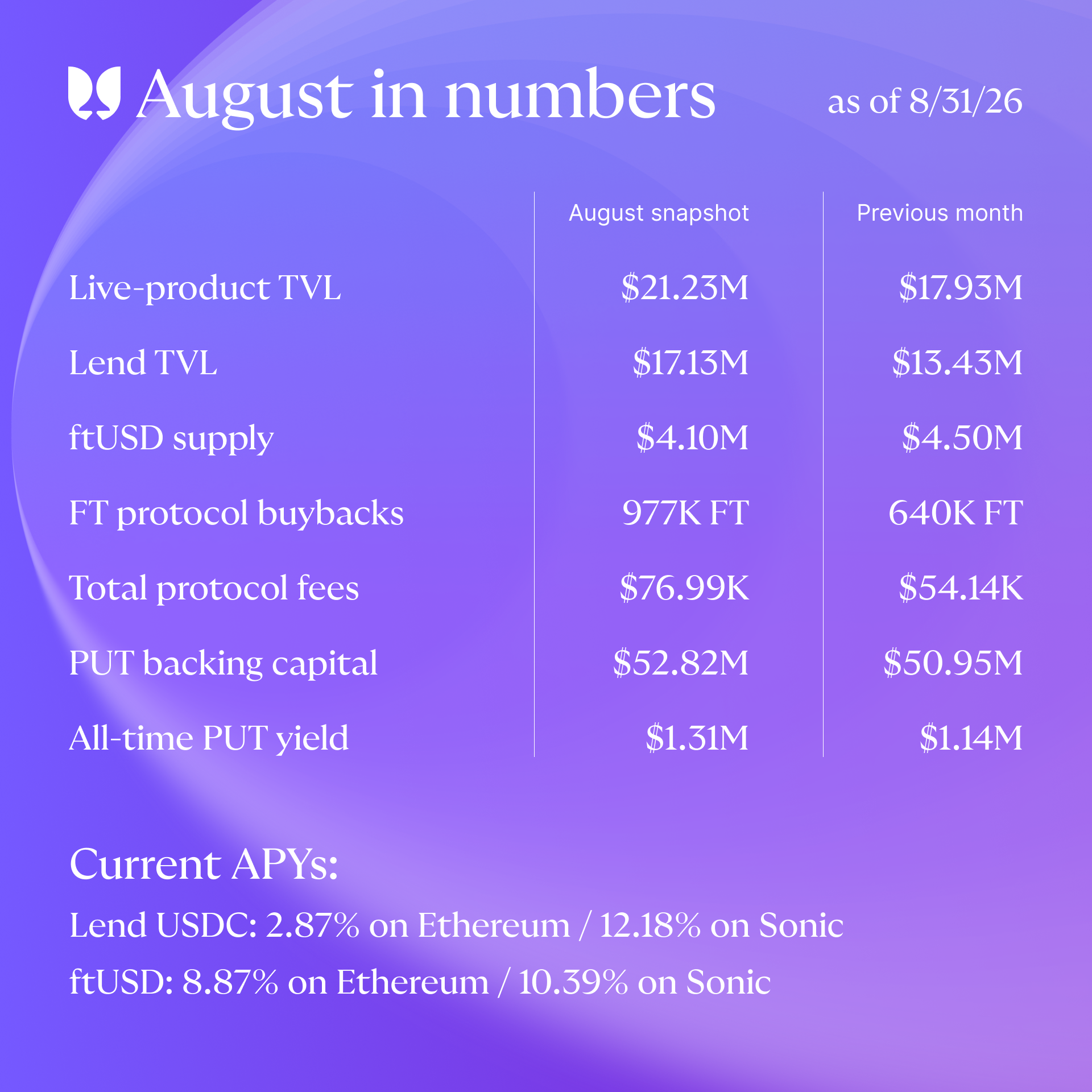
August marks six months since Flying Tulip launched. It was also a strong month for growing the product suite. Lend TVL and ftUSD supply reached new all-time highs, borrowing activity increased, fees and FT buybacks made new daily records, and the next products in the stack moved much closer to launch.
By August 31, live-product TVL had reached $21.23 million, including $17.13 million in Lend and $4.10 million in ftUSD. This growth came without FT token incentives or liquidity mining. Users were drawn by attractive yields and ease of use, with activity across the live products generating increasing fees and revenue.
In fact, revenue is now growing faster than PUT backing is being withdrawn, while total PUT backing remained above $50 million for another month. At the six-month milestone, three of sixteen planned products were active across two of nine planned chain deployments, leaving most of the roadmap still ahead.
1.From DeFi to onchain finance
The first generation of DeFi proved that financial logic could operate on public blockchains. Protocols were often immutable and narrowly focused: lending markets handled lending, AMMs handled swaps, and vaults automated the movement of capital between them. This model also fragmented users and capital across separate protocols. Capital supplied to one product could rarely support another activity without first being withdrawn, wrapped, transferred or redeployed.
The industry is now moving toward a broader model of onchain finance. Modern onchain financial systems require active risk management, operational security, better UX, user support and the ability to adapt as markets change. They may involve companies, curators and risk analysts, but they also need to preserve the most important benefits of blockchain-based finance: direct control of assets, transparent rules, open participation and independently verifiable activity.
Flying Tulip is being built for this next phase. Its broader objective is to combine the functionality users associate with centralized financial venues with non-custodial ownership and verifiable onchain settlement.
One account, more productive capital
Flying Tulip is being built from scratch as a connected onchain financial system, not as a collection of isolated protocols. Its products are designed to work together, sharing a common framework for collateral, credit, pricing, settlement and account health. This reduces idle capital, unnecessary transfers, wrappers, approval flows, fee hops and fragmented accounting.
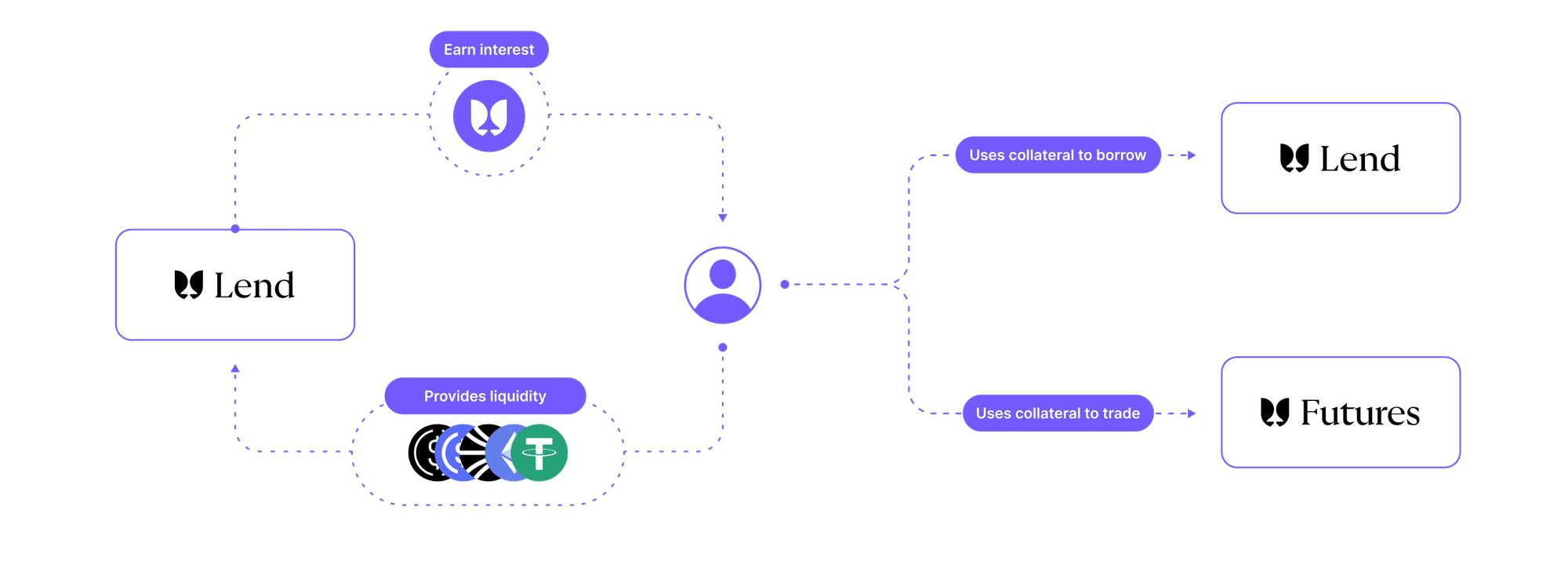
At the center of the system is a shared account and collateral layer. Capital deposited into Lend is designed to support multiple activities within predefined risk limits: earning yield, providing borrowing power and backing trades or open orders. As the product suite expands, the same account infrastructure will also support synthetic exposure, derivatives and insurance.
Each part of the stack has a distinct role, and each new product is designed to increase the utility of the products already live:
- ftUSD provides liquidity and a common settlement layer.
- Lend provides the account-based collateral, borrowing and margin layer.
- Trade adds spot and leveraged spot execution.
- TRS extends the same infrastructure into leveraged synthetic exposure.
- Future products reuse the same collateral, execution, pricing and settlement systems for derivatives, insurance and permissionless markets.
Growing and hardening the live stack: Lend and ftUSD
By August 31, Lend TVL had reached $17.13 million across Ethereum and Sonic, up from $13.43 million at the previous monthly snapshot. Total borrows reached approximately $4.7 million, including $3.79 million on Ethereum and $908k on Sonic.
In August, interest-rate models for S, ETH, USDC, USDT and ftUSD were optimized to reduce borrowing costs. To support additional demand while preserving risk controls, several caps were also increased.
On Sonic:
- the wS borrow cap increased from 8 million to 12 million wS;
- the stS supply cap increased from 8 million to 12 million stS.
On Ethereum:
- the WETH borrow cap increased from 100 to 200 WETH.
These updates reflect Flying Tulip’s approach to scaling products: start with lower caps → observe real utilization and available liquidity → then expand capacity as the market and infrastructure mature.
In August, ftUSD supply remained stable at $4.1 million. This includes approximately $3.8 million on Ethereum and $301k on Sonic.
Users can mint, stake, unstake and redeem ftUSD without lockups or external redemption queues. The current strategies combine yield on stablecoin collateral with delta-neutral exposure involving the native asset and its staked equivalent, allowing ftUSD to generate yield without relying solely on borrower demand or an external credit counterparty.
These strategies operate entirely onchain, with collateral, positions, leverage, borrowing costs and resulting yield all visible through the ftUSD dashboard.
Activity flows back into FT
As more products come online and usage grows, more fees and revenue flow into open-market FT buybacks. There is no additional supply pressure: Flying Tulip does not inflate FT to subsidize user activity or yield. The team received no token allocation; team rewards are tied to revenue-funded FT buybacks.
By August 31:
- total protocol fees had reached $77k;
- protocol buybacks had crossed 977,734 FT;
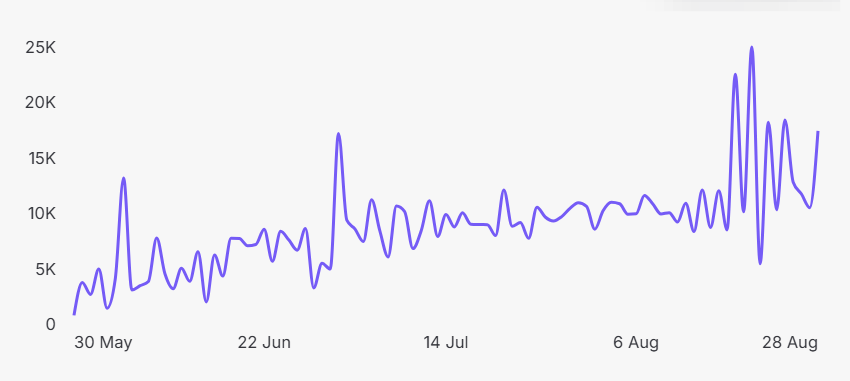
- buybacks set two new daily records in August, with more than 24k FT and 25k FT bought back.
The FT/ftUSD pool on Curve continued to deepen liquidity. At the August 31 snapshot, FT/ftUSD LPs were earning 31.98% APY, with up to 99.57% max boost. LP activity will also be eligible for Flying Tulip points.
Add and stake FT/ftUSD liquidity to earn rewards
2.Coming next: Trade, TRS and Beyond
Throughout August, Trade and Total Return Swaps (TRS) continued through testing, optimization and hardening, with beta access available to selected Discord roles. Together, they bring execution and synthetic exposure into the same account and collateral infrastructure already used by Lend and ftUSD.
Trade adds spot and leveraged spot to the Flying Tulip stack. Users will be able to swap supported assets, place market or limit orders, and open leveraged long or short positions without moving collateral to a separate venue. Because Trade is integrated with Lend, it uses the same margin account, borrowing capacity and collateral system, adding more utility to capital already deposited in Flying Tulip.
TRS extends this infrastructure into perp-like exposure. It gives users economic exposure to a reference asset without requiring them to own the full underlying position. Widely used in traditional finance, this structure is difficult to reproduce efficiently across fragmented DeFi protocols. Flying Tulip’s integrated infrastructure makes it possible to bring it onchain, using the existing collateral, lending, execution and settlement infrastructure.
The main difference from conventional perps is the financing model. Rather than relying on a standardized perpetual-funding convention, TRS financing is based on the net economics of collateral yield and the actual cost of borrowing the assets required to construct the position. This can make financing materially cheaper than a comparable perp.
TRS is also designed without auto-deleveraging (ADL). Because the exposure is constructed through a spot-based system, a position can remain open as long as the account continues to meet its margin requirements. If liquidation is required, Flying Tulip issues an RFQ and uses the best available bid to sell only what is needed to repay debt and restore account health. This is designed to improve execution and reduce unnecessary losses compared with mechanisms that automatically transfer collateral at a predetermined discount.
Work also continued beyond the immediate product launches.
Flying Tulip’s atomic-settlement system is being developed to bridge the gap between immediate onchain liquidity and T+1 to T+5 settlement for tokenized real-world assets. The same liquidity engine could help liquid-staking-token issuers offer faster redemptions when the underlying asset has a delayed settlement window, without first having to build a deep onchain market.
Development also continued on curator infrastructure, atomic settlement, permissionless markets and expansion to additional networks. BNB Chain remains the next planned deployment after Ethereum and Sonic.
3.Flying Tulip in the media
In August, Flying Tulip team members joined Cointelegraph, The Block and More Than Speculation for conversations about DeFi’s evolution, the architecture behind Flying Tulip and what comes next.
Andre Cronje with Cointelegraph: DeFi and onchain finance
“It is just code. I’m a developer who really enjoys building stuff.”
Andre Cronje joined Cointelegraph to discuss why most modern protocols no longer fit the strict original definition of decentralized finance.
Under that original model, DeFi required decentralization, immutability and no intermediaries. Users interacted directly with contracts whose rules could not be changed. Modern protocols increasingly include teams, upgradeable systems, curators, risk committees and offchain operational infrastructure.
That does not make onchain settlement or transparency irrelevant. It means the trust assumptions have changed and need to be described honestly. This broader category is better understood as onchain finance.
Onchain finance acknowledges that teams, curators and active risk management exist while preserving direct control of assets, transparent rules and open participation. For broader adoption, it also needs to work for people without a deep technical background, requiring better UX and user support.
On centralized exchanges, everything starts with a margin account that users deposit into. This lets them earn interest, open leveraged positions, trade spot, and use their assets as collateral for derivatives from the same account.
Flying Tulip applies the same account-based model onchain, allowing the same capital to perform more functions while remaining inside a non-custodial system.
The discussion also covered why complex lending markets cannot remain entirely static. Assets and liquidity conditions change, and every asset accepted into a cross-collateral market introduces risk to the wider credit book. Active risk analysis is therefore an essential part of the product rather than a compromise imposed from outside.
🎙️ "I don't think DeFi exists anymore outside of very small niches."@rkbaggs sat down with @AndreCronjeTech, founder of @flyingtulip_, to talk about the evolution of DeFi and how immutability has gone from a feature to a bug.#CHAINREACTION pic.twitter.com/aga10hXurZ
— Cointelegraph (@Cointelegraph) August 13, 2026
Anton Nell on More Than Speculation: Where DeFi is going
“A lot of people think that DeFi is dying, and I just think that the early version of DeFi is slowly dying.”
Anton Nell joined More Than Speculation to discuss the transition from fragmented DeFi toward onchain finance and how Flying Tulip is pioneering this new phase.
Historically, most DeFi products were designed around a single financial primitive. Lending, swaps, yield and derivatives operated in separate systems. A user might go to Aave for lending, Uniswap for swaps and other protocols for everything else. Capital supplied to one protocol generally could not support a limit order or derivatives position without first being withdrawn and moved elsewhere.
Protocols have attempted to improve capital efficiency through mechanisms such as receipt tokens, where a token representing a deposit can be used in another protocol. But this still means stitching together independent systems that were not originally designed to function as one financial account.
Traditional financial platforms work differently: users can access payments, credit, investments and other services through the same account infrastructure. To achieve this onchain, the system needs to be designed around integration from start. Pieces of unrelated protocols cannot simply be stitched together and expected to operate as one account.
Flying Tulip is therefore being built from scratch around a connected account and collateral layer that can support lending, borrowing, trading and open orders, and eventually derivatives and insurance.
The long-term goal of Flying Tulip is to become a one-stop shop where users can deposit capital and access financial products without needing to understand which underlying DeFi primitive they are interacting with. For users seeking exposure to crypto today and potentially real-world assets later, the experience should increasingly resemble a complete financial venue rather than a collection of separate applications.
To reach its users, Flying Tulip is scaling in two directions:
- Horizontally, by expanding the stack across blockchains. Flying Tulip is currently deployed on Ethereum and Sonic, with BNB Chain planned as the next deployment.
- Vertically, by increasing liquidity and adding more products and deeper liquidity to each existing deployment, creating a more useful ecosystem. More capital makes those products more useful, creating the potential for a natural growth flywheel.
The broader objective is for Flying Tulip to make any supported L1 or L2 function more like a complete exchange environment, offering users lending, trading and other financial functionality from the same stack.
The conversation also covered Flying Tulip’s non-inflationary token model, PUT-backed capital structure and security-first approach. Rather than inflating FT to subsidize activity, the system is designed to grow from real product usage. The PUT structure also encourages more deliberate expansion because the backing capital remains available for redemption. The priority is not to launch the most products as quickly as possible, but to build a connected financial system that can mature safely over time.
"People think that DeFi is dying, instead, I think that the early version of DeFi is slowly dying"
— More Than Speculation (@morethanspecpod) August 26, 2026
Anton, co-founder of @flyingtulip_ shared his view on the problem of DeFi and where is DeFi going.
Timestamps
00:26 Intro & Anton Nell's background — Andre Cronje's right-hand man… pic.twitter.com/edPQfx0Sq3
Andre Cronje on The Block: From Immutable DeFi to Capital-Efficient Onchain Finance
"Immutability used to be a feature. Nowadays, I think it's a bug."
The conversation traced Andre’s path from financial infrastructure and early yield automation to the integrated account model behind Flying Tulip.
An earlier generation of immutable protocols operated under fixed rules, with few intermediaries or fee layers. That made composability relatively straightforward because developers knew the systems beneath them would not change.
Today, protocols are more complex onchain financial systems with active risk management, upgradeable contracts and multiple counterparties. Flying Tulip is being built around these broader trust and security assumptions while keeping protocol activity onchain and verifiable.
Rather than requiring users to move wrapped assets through separate lending markets, AMMs and aggregators, Flying Tulip's product stack shares the same account, collateral and settlement infrastructure.
A Lend cross-collateral margin account acts as the user’s entry point. Users can deposit and earn yield, borrow against the value of the account, swap assets, place orders and, as the product suite expands, access leveraged and synthetic exposure. This is the same type of functionality that often draws users to centralized exchanges, but delivered through a non-custodial, onchain system.
Exploring the origins of DeFi protocols with Andre Cronje https://t.co/rxkwW64Hp0
— The Block (@TheBlockCo) August 19, 2026
If you made it this far, join the Flying Tulip community for the latest updates on Discord: https://discord.gg/flyingtulip, and on Telegram: https://t.me/flyingtulipgroup.
Links
Socials
- Website: https://flyingtulip.com
- X/Twitter: https://x.com/flyingtulip_
- Discord: https://discord.gg/flyingtulip
- Telegram Chat: https://t.me/flyingtulipgroup
- Telegram Announcements: https://t.me/flyingtulipann
Products
- PUT Marketplace: https://marketplace.flyingtulip.com
- ftPUT: https://flyingtulip.com/allocation/dashboard
- ftUSD: https://flyingtulip.com/ftusd/dashboard
- Lend: https://flyingtulip.com/lend/dashboard
Documentation
- FT Token: https://docs.flyingtulip.com/product-suite/ft-token
- ftUSD stablecoin: https://docs.flyingtulip.com/product-suite/ft-usd
- Roadmap: https://docs.flyingtulip.com/roadmap
- Contract addresses: https://docs.flyingtulip.com/contract-addresses
Official Dashboards
- PUT Options Overview https://flyingtulip.com/allocation/dashboard
- Lend Stats: https://flyingtulip.com/lend/dashboard
- ftUSD Stats and APY Breakdown: https://flyingtulip.com/ftusd/dashboard
- Protocol Fees and FT Supply: https://flyingtulip.com/statistics
Community and Partner Dashboards
- FT Onchain Supply (including FT buybacks, and the burned, circulating and non-circulating supply: https://ftdashboard.xyz/
- PUTs Marketplace: https://ftdashboard.xyz/puts-marketplace.html
- Circuit-Breaker Status (with alerts): https://ftcircuitbreaker.com/
- Sonic/ETH Metrics and Borrow-Loop Calculator: https://flyingtulip-dash.vercel.app/
- Impossible Tracker of All Metrics: https://flyingtulip.impossibuild.ai/
- Token Terminal: https://tokenterminal.com/explorer/projects/flyingtulip