Flying Tulip July Update

Flying Tulip is an on-chain financial system that standardizes pricing, credit and risk across an integrated suite of products. ftUSD provides the liquidity and settlement layer, while Lend provides the account-based margin and capital-efficiency layer. Spot, leveraged trading and Total Return Swaps extend the same collateral and account infrastructure into execution and synthetic exposure.
The system is designed as one connected stack, so capital never needs to sit idle. Stablecoin liquidity supplied through ftUSD and assets supplied to Lend can continue earning yield while supporting borrowing, open Spot orders, margin positions, derivatives and insurance, with settlements in ftUSD.
In July, Flying Tulip moved further beyond individual product launches toward a more integrated on-chain financial system. Spot and TRS entered private beta, available to some roles on Discord. RWA and LST atomic-settlement systems were activated, and two large curators began proof-of-concept integrations using their own collateral, with settlement in FT.
The roadmap expanded to include tokenized perps and tokenized leverage. Alpha testing continued on the order book, an on-chain derivative primitive, and permissionless markets in which risk parameters for lending and derivatives can be derived from the liquidity, reserves, prices and volatility of the underlying AMM. As ftUSD integrations and liquidity expand, PUTs are planned to be added as collateral, a feature frequently requested by users.
Few niche milestones this month;
— Andre Cronje (@AndreCronjeTech) July 24, 2026
1. $1m in funding officially reached. 🥳
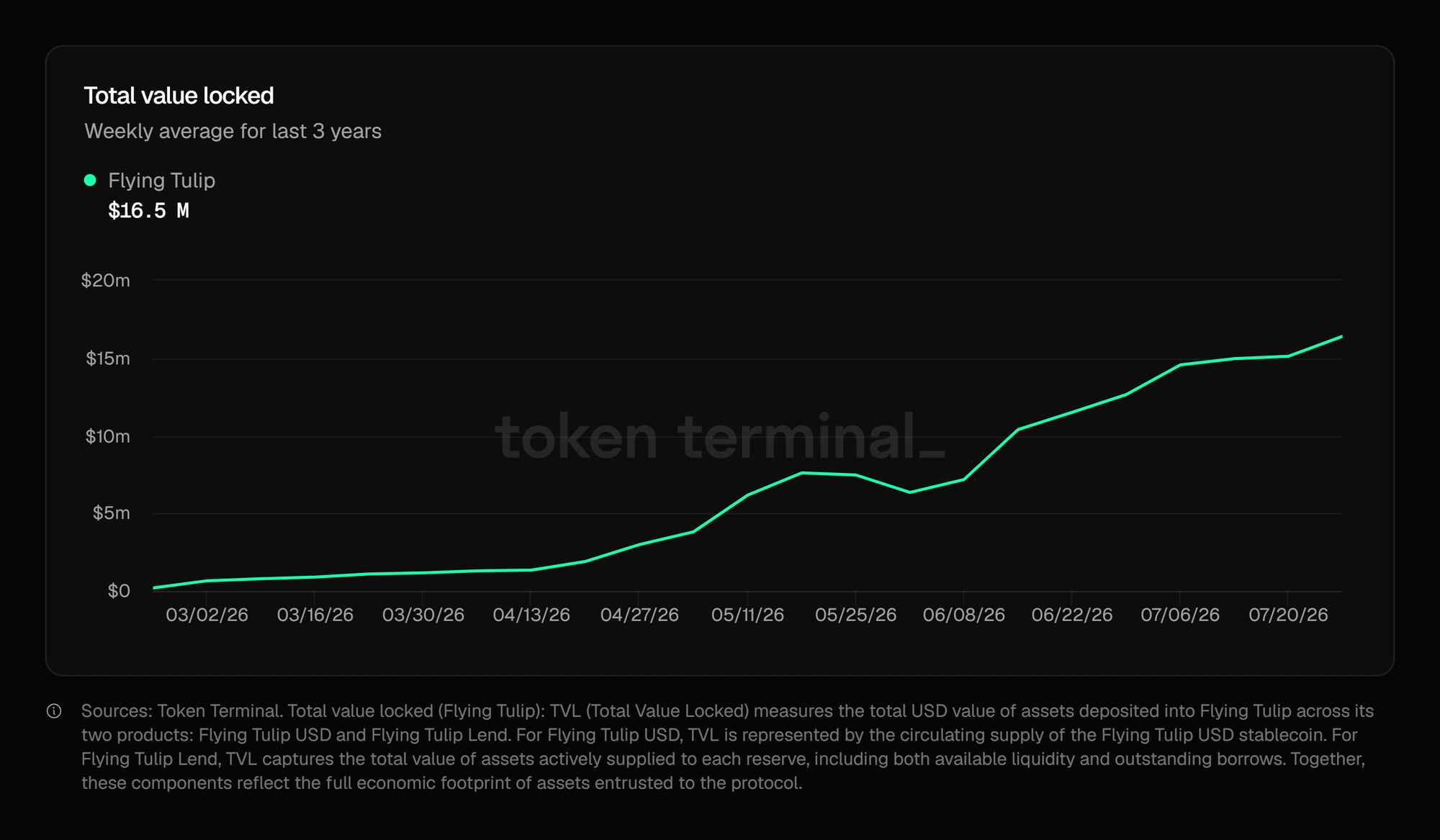
2. TVL over $15m (ex Options, incl Options $70m), with 0 incentives in 4 months (for context yearn took 2 years to reach $8m).
3. ftUSD has maintained its > 7% APY target / anchor for 3 consecutive months… https://t.co/xySJ0OtY4c
The live products continued to mature, with parameters adjusted to support greater scale while preserving risk controls. The ftUSD cap on Ethereum increased from $5 million to $100 million; the ftUSD mint and redeem fee was reduced from 10 to 7 basis points; Sonic Lend S borrow cap increased from 5 million to 8 million; Lend Circuit Breaker limits were raised on Ethereum; and borrow cap on Sonic Lend increased from 10K to 100K ftUSD.
At the time of writing, TVL across live products reached about $18 million, while the broader on-chain capital base is at approximately $70 million, including PUT backing. All-time yield generated by PUT backing exceeded $1.2 million. Lend reached $13.43 million across Ethereum and Sonic, with active loans surpassing $1.3 million. ftUSD supply also continued to grow, reaching $4.5 million, while Ethereum ftUSD APY remained above 7% for a third consecutive month.
This growth was achieved without liquidity-mining or token incentives.
In addition to burning 8.8 billion FT (see next section), efforts continued to deepen liquidity for FT and ftUSD ahead of the Spot launch. Curve DAO Proposal #1455 passed with 100% support, approving the FT/ftUSD gauge and making the pool eligible for CRV emissions based on gauge weight.
ftUSD total supply: $4.5M (from $3.94M last month)
— $4.14M on Ethereum
— $360.5K on Sonic
ftUSD APY:
— 10.17% on Ethereum
— 5.6% on Sonic
Lend TVL: $13.43M (from $9.56M last month)
— $12.05M on Ethereum
— $1.39M on Sonic
FT Protocol Buybacks: 640,512 FT
All-time yield generated: $1.14M
Total backing capital: $50.95M
For the latest figures, see ftUSD Dashboard, Lend Dashboard, Allocation Dashboard, and the new Statistics page.
1. We just burned $900,000,000
In a single transaction in July, we permanently burned 8,788,534,107 FT, approximately 88% of total supply, reducing the fully diluted valuation (FDV) to roughly $100 million.
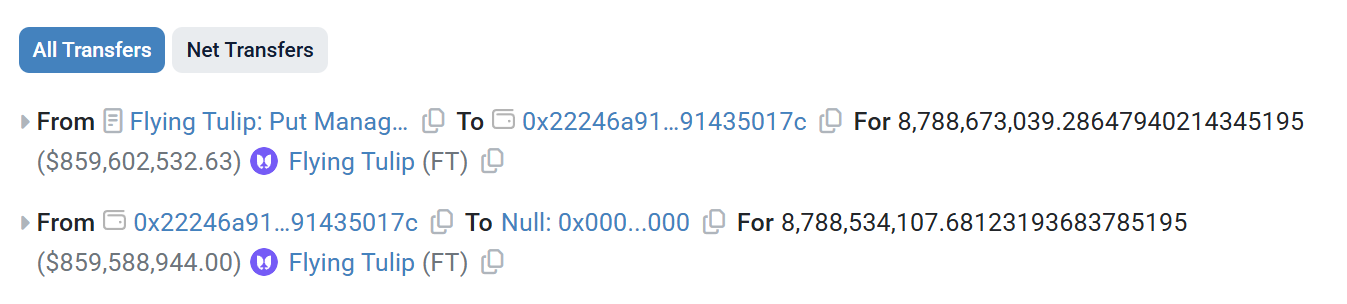
These tokens were unallocated FT held in the Investment Contract’s Perpetual PUT reserve as non-circulating supply. They could enter circulation only through new capital deposited to purchase them.
Following the burn, now they never can.
The dedicated post explains the transaction and its effect on FT supply in detail.
 Andre Cronje
2. Dashboard County
At Flying Tulip, we build our products on-chain and treat transparency as an integral part of the product. Even before July, every major live product had a dedicated official dashboard.
The PUT Options dashboard tracks backing capital, collateral allocation and yield generated. The Lend dashboard shows supplied capital, borrows, earnings, available liquidity and APYs across Ethereum and Sonic. The ftUSD dashboard tracks supply and staking APY and breaks down the underlying collateral.
These dashboards are complemented by several community and partner tools. The FT dashboard tracks on-chain supply, including protocol buybacks, burns, and circulating and non-circulating supply. Its PUTs Marketplace view follows active listings, holders and recent activity. Other tools monitor Circuit Breaker status and provide alerts, compare Sonic and Ethereum metrics, and model borrow loops.
In July, we expanded this public data layer further. The objective is simple: make activity across Flying Tulip visible and independently verifiable at every level, from high-level protocol metrics to individual contracts and positions, down to the wei.
ftUSD strategy dashboard
The current ftUSD strategy is entirely on-chain, liquid and transparent. The strategy combines yield from stablecoin collateral with a delta-neutral position involving ETH and staked ETH on Ethereum, or S and staked S on Sonic.
The expanded dashboard now separates ftUSD APY into stablecoin collateral yield and delta-neutral strategy yield. It also shows leverage, borrow APY, staking APY, projected sftUSD APY, and the profitability of the delta-neutral leg.


Protocol Statistics
The new Statistics page consolidates protocol fees and shows how cash flows are routed toward FT buybacks. It includes cumulative and period-based fees, annualized figures, breakdowns by product and network, and claimed and unclaimed fees.


Token Terminal
Flying Tulip is now live on Token Terminal, providing an independent, standardized view of activity across the protocol. The profile tracks metrics including TVL, active loans, ftUSD supply, yields, fees, supply-side fees and protocol revenue, with historical charts showing how these figures evolve over time.


Because Token Terminal applies consistent definitions across projects, Flying Tulip can now be compared directly with other on-chain financial systems. Token Terminal also maintains a labeled registry of the protocol’s smart contracts across chains. This connects the reported metrics to the underlying contracts and creates an additional external data layer for tracking capital, activity and fees.
🆕🤝 We’re excited to announce our Data Partnership with @flyingtulip_!
— Token Terminal 📊 (@tokenterminal) July 21, 2026
Flying Tulip is an onchain financial system that standardizes pricing, credit, and risk across a suite of products.
Learn more. 🧵👇 pic.twitter.com/pHiof9ySbi
Impossible tracker
Impossible launched a consolidated tracker that brings PUT collateral, ftUSD supply, Lend activity, markets, revenue, risk parameters and contract-level analytics into one place. Each published metric includes its source and methodology, with data drawn from Flying Tulip APIs and on-chain sources.


3. Quick Product Notes: Atomic Settlements and Curator Infrastructure
Atomic liquidity for RWAs and LSTs
Many tokenized real-world assets have substantial off-chain value but limited on-chain liquidity and delayed settlement. An asset can represent billions in assets under management (AUM) while having too little immediately executable liquidity to support on-chain lending or liquidations.
Flying Tulip can provide credit against these assets while using atomic settlement to bridge the gap between immediate on-chain liquidity and T+1 to T+5 settlement. Estimated instant-settlement costs range from 1 to 3 basis points, depending on the asset and settlement period.
A big problem for RWA projects is onchain liquidity, this limits their adoption in lending markets (and credit facilities). An asset might be 100bn in AUM, but it has $10k in onchain liquidity and T+1-5 settlement. Liquidation engines can't work under those assumptions.
— Andre Cronje (@AndreCronjeTech) July 16, 2026
At…
The same design can be used by liquid-staking-token issuers whose underlying redemption takes time. An EVM-based LST with a T+x settlement window could use Flying Tulip liquidity to offer immediate redemption without first building a deep, independent on-chain market. Deeper and faster exit liquidity can, in turn, support more useful collateral parameters in lending markets.
RWA and LST atomic settlement were added to the roadmap in July.
If you are an EVM based LST issuer and have a T+x settlement window, @flyingtulip_ can turn that into atomic liquidity without needing to build onchain liquidity.
— Andre Cronje (@AndreCronjeTech) July 21, 2026
Offer instant redemption at lower rates. For T+7 you would look at 3 bips fee. Healthier liquidity means better LTV.
Infrastructure for institutional vault curators
Early vaults were often managed by one or two strategists whose primary role was to allocate deposits across other protocols. Today, large curators increasingly operate as full institutions.
In that environment, simply deploying capital into external markets is no longer enough to differentiate a vault. Curators may need to offer leverage, margin trading, cross-collateral accounts, Spot execution, RFQ routing, TRS and derivatives using the same pool of deposited capital.
Flying Tulip is being developed as infrastructure that allows curators to offer those functions without building the full lending, account, execution and settlement stack themselves.
By late July, two large curator proof-of-concept integrations were underway.
When I invented the first defi vaults in 2020 curation was up to 1-2 strategist. Nowadays curation is managed by entire full fledged institutions.
— Andre Cronje (@AndreCronjeTech) July 16, 2026
Vaults that just deploy capital are no longer competitive, you need vaults that can offer depositors their own leverage, margin… pic.twitter.com/IPOxrCA2VD
4. Andre Cronje on The Rollup: From DeFi to on-chain finance
Andre joined The Rollup for a deep dive into the ideas shaping Flying Tulip and the broader shift from early DeFi toward more mature on-chain financial systems.
The Biggest DeFi Boom Is Yet To Come (Entire Thesis) with @flyingtulip_ founder @AndreCronjeTech
— The Rollup (@therollupco) July 18, 2026
00:00 Intro
05:58 Security Versus UX Tradeoffs
11:05 Decentralization Is Dead
17:28 Curated Vaults Hide Real Risk
21:00 Flying Tulip's Core Thesis
23:05 Rebuilding DeFi… pic.twitter.com/LwHosJSArn
Security is more than an audit
There are trade-off between rollout speed, user experience and security. While audits remain necessary, they are no longer enough for modern protocols. Production security also requires secure key management, upgrade controls, outflow monitoring, capped rollouts and Circuit Breakers.
If limits are exceeded, a Circuit Breaker may place a withdrawal into a queue rather than sending funds immediately, and a cap may prevent a product from accepting all available demand. These protections can introduce some friction, but they are necessary for the next generation of on-chain products. Together, they can substantially improve security by limiting the speed and scale of outflows during an incident.
Flying Tulip also strictly separates permissions: roles that can move funds are distinct from those that can pause or slow outflows, while the highest-risk actions sit behind multisigs and timelocks.
Andre Cronje (@AndreCronjeTech) explains why DeFi is finally choosing security over convenience using the one analogy everyone understands.
— The Rollup (@therollupco) July 17, 2026
"The old fight between security and user experience is as old as time," he says.
Think passwords: "1-2-3" is easy and unsafe, so the… pic.twitter.com/THbXsZRKTj
From decentralized finance to on-chain finance
The industry has moved beyond the original model in which the user’s only counterparty was an immutable smart contract. Modern products rely on teams, hosted interfaces, support channels, keepers, security operations, curators and external infrastructure.
Upgradable contracts have also become necessary for complex financial products. They introduce additional trust and key-management risks, but a fully immutable system cannot respond to newly discovered problems or continue adapting. The important issue is not that teams and off-chain systems exist, but that their role and the resulting trust assumptions are disclosed clearly.
Curated vaults are one example. A vault may execute transactions on-chain, but the user can still be exposed to a curator’s decisions, an off-chain credit agreement, an RWA issuer or an asset that cannot be liquidated immediately. Transparency must include these counterparties rather than imply that the smart contract is the only source of risk.
This category can be better understood as on-chain finance rather than DeFi. Accordingly, Flying Tulip is being built for the next cohort of users who expect modern financial functionality alongside on-chain transparency.
Andre Cronje says a lot of "DeFi" now hides an off-chain counterparty behind a smart-contract UI.
— The Rollup (@therollupco) July 18, 2026
"There's a disconnect between what's being presented and what it actually is. That's where the risk comes in." pic.twitter.com/oWEtt9HfHD
Rebuilding composability inside one system
The original DeFi protocols were easy to build on because they were often largely immutable and charged few or no fees. The prevailing design goal was full immutability and decentralization.
As protocols have become versioned, fee-generating businesses, building across separate systems has become harder. Each protocol must protect and optimize for its own liquidity and fee streams, making external composability more difficult.
Andre Cronje on why he built Flying Tulip the way he did:
— The Rollup (@therollupco) July 18, 2026
"Flying Tulip is the composability of a lending market that feeds directly into an order book, into derivatives and insurance, settled by our native stablecoin, Flying Tulip USD."
"It makes more sense if you go back to… pic.twitter.com/SpZYlj0dSS
Retail and institutional capital ultimately follows the product that offers the best combination of risk-adjusted yield, functionality and cost.
To provide this, Flying Tulip is designed as one connected stack, bringing together lending, equity-based margin accounts, Spot execution, RFQ routing and liquidations, derivatives and ftUSD. The goal is to restore composability within a single account and settlement system.
Flying Tulip’s dollar-pegged stablecoin ftUSD is much more than just a stablecoin – it serves as the settlement asset and the connective liquidity layer.
Stablecoin deposits earn yield from borrowers, and support the delta-neutral strategy while providing liquidity across the product suite. Capital entering Lend margin accounts feeds into the Spot order book, margin positions, RFQ execution and liquidations. Those same accounts can then support TRS, derivatives, insurance and future permissionless markets.
As activity grows, increased borrowing demand and fees from trading, liquidations and settlement contribute to ftUSD yield, creating a liquidity flywheel across Flying Tulip. This gives ftUSD multiple sources of demand and yield rather than making it dependent on a single strategy or product.
ftUSD is both the liquidity “Trojan horse” and the lifeblood of the system.
"Deposited capital is onboarded in the same margin account. If you can place a limit order on our spot system, that capital is earning yield because it's in the margin account being lent out on the other side. There’s never a point where your capital isn’t put to work."
- Andre Cronje
If you made it this far, join the Flying Tulip community for the latest updates on Discord: https://discord.gg/flyingtulip, and on Telegram: https://t.me/flyingtulipgroup.
Links
Socials
- Website: https://flyingtulip.com
- X/Twitter: https://x.com/flyingtulip_
- Discord: https://discord.gg/flyingtulip
- Telegram Chat: https://t.me/flyingtulipgroup
- Telegram Announcement: https://t.me/flyingtulipann
Products
- PUT Marketplace: https://marketplace.flyingtulip.com
- ftPUT: https://flyingtulip.com/allocation/dashboard
- ftUSD: https://flyingtulip.com/ftusd/dashboard
- Lend: https://flyingtulip.com/lend/dashboard
Documentation
- FT Token: https://docs.flyingtulip.com/product-suite/ft-token
- ftUSD stablecoin: https://docs.flyingtulip.com/product-suite/ft-usd
- Roadmap: https://docs.flyingtulip.com/roadmap
- Contract addresses: https://docs.flyingtulip.com/contract-addresses
Official Dashboards
- PUT Options Overview https://flyingtulip.com/allocation/dashboard
- Lend Stats: https://flyingtulip.com/lend/dashboard
- ftUSD Stats and APY Breakdown: https://flyingtulip.com/ftusd/dashboard
- Protocol Fees and FT Supply: https://flyingtulip.com/statistics
Community and Partner Dashboards
- FT Onchain Supply (including FT buybacks, and the burned, circulating and non-circulating supply: https://ftdashboard.xyz/
- PUTs Marketplace: https://ftdashboard.xyz/puts-marketplace.html
- Circuit-Breaker Status (with alerts): https://ftcircuitbreaker.com/
- Sonic/ETH Metrics and Borrow-Loop Calculator: https://flyingtulip-dash.vercel.app/
- Impossible Tracker of All Metrics: https://flyingtulip.impossibuild.ai/
- Token Terminal: https://tokenterminal.com/explorer/projects/flyingtulip