Flying Tulip October Update

Flying Tulip's goal is to make every supported L1 or L2 a complete onchain financial venue: one place to deposit capital, earn yield, borrow, trade and hedge without needing to understand the underlying DeFi primitives. The same account will connect crypto markets with a broader range of real-world assets.
We are building towards that goal horizontally, by expanding across blockchains, and vertically, by adding products and deepening liquidity on each chain. Flying Tulip is already deployed on Ethereum, Sonic and BNB Smart Chain, with Monad planned next. Deeper liquidity makes lending and trading more efficient, helping attract further capital and activity to the same connected stack.
Flying Tulip’s mission: make every supported blockchain a full-featured onchain exchange.
— flyingtulip.com (@flyingtulip_) October 21, 2026
Lending, yield, spot and margin trading, and hedging through one account, built to maximize yield, capital efficiency and composability. pic.twitter.com/w5FQfWsBPy
October was a month of optimizing and improving our products and how they work together, making it easier to earn, borrow and trade through the same account. FT can now be used as collateral on Ethereum, while the new Swap connects wallet swaps, account swaps and limit orders in one interface. Higher Lend caps expanded capacity across all three networks, and integrations with vaults.fyi and Turtle opened additional routes into Flying Tulip’s yield products.
Product activity and capital yield continued to create demand for FT. Protocol buybacks passed 1.7 million FT, while cumulative protocol and NAV buybacks and burns exceeded $3 million. Separately, an additional 330 million unallocated FT was burned in October.
Perpetual PUTs combine FT’s upside with the right to redeem the original backing asset, giving buyers a way to acquire protected exposure. All-time yield generated by that backing crossed $1.5 million, funding development and team operations. Users can buy and sell these positions on the Flying Tulip's PUT Marketplace, which had its most active month in October.
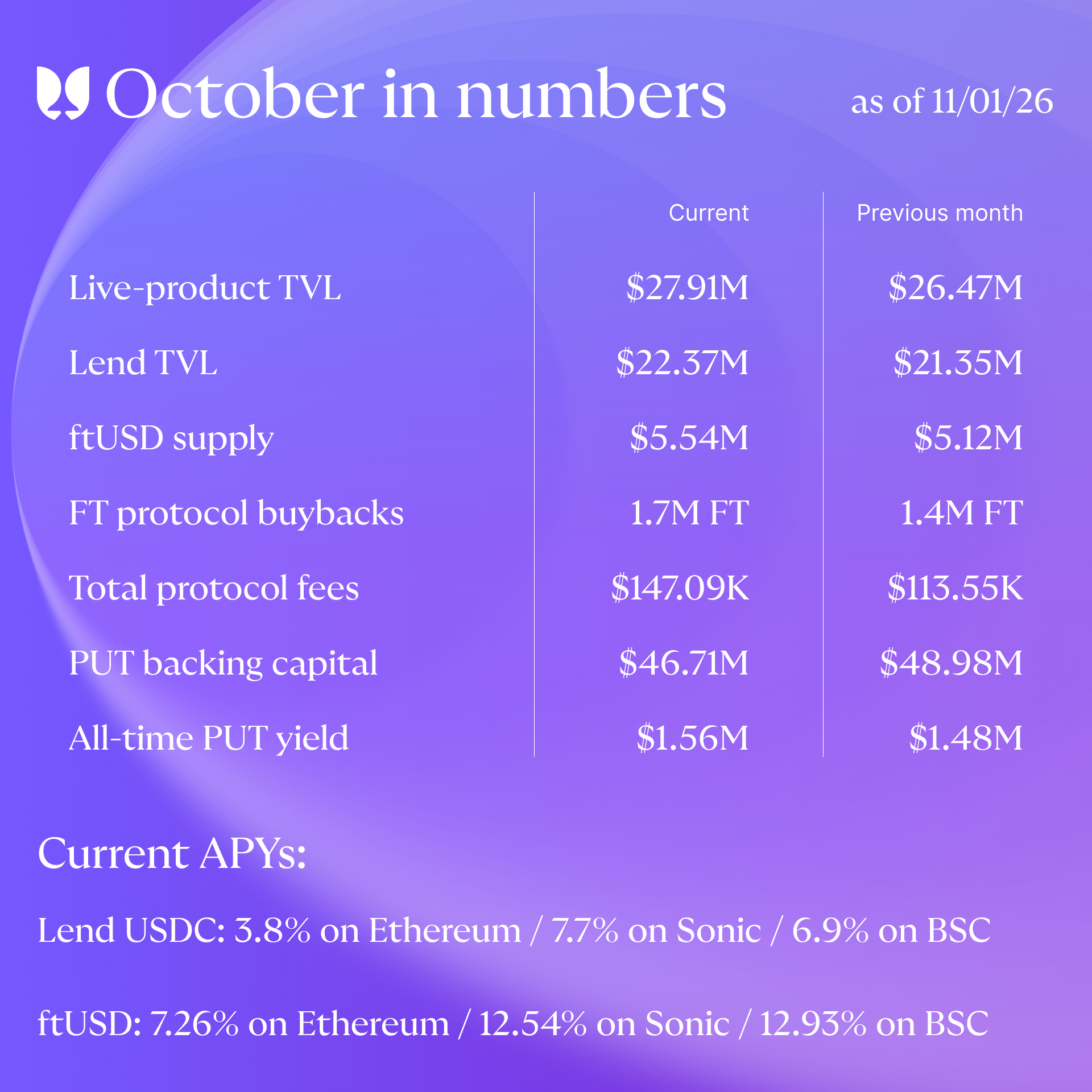
Products continue to grow. As of November 1, ftUSD supply was at $5.54 million, while Lend TVL was at $22.37 million across Ethereum, Sonic and BNB Smart Chain. You can mint and stake ftUSD to earn, or supply assets to Lend to earn yield and use it as collateral:
- sftUSD: Stake ftUSD to receive yield paid in FT purchased on the open market. Current APY: 7.3% on Ethereum, 12.5% on Sonic and 12.9% on BNB Smart Chain.
- ssftUSD: The auto-compounding option, which reinvests yield into more ftUSD, increasing the amount of ftUSD you can redeem over time. Current APY is 7% on Ethereum.
- USDC on Lend: 3.8% APY on Ethereum, 7.7% on Sonic and 6.9% on BNB Smart Chain.
1. Security as a priority: Circuit breakers
Security depends on both the audits performed before deployment and how the system behaves when something goes wrong.
Flying Tulip’s circuit breakers protects against exploits by limiting how much value can leave the protocol within a time window. If the outflow exceeds defined thresholds and appears abnormal, requests above that capacity are restricted or queued, slowing potential outflows and giving the team time to investigate, respond and contain an incident.
This protection applies across flows including PUT withdrawals, ftUSD redemptions and lending withdrawals. It works alongside controlled supply and borrowing caps, monitoring and defined operational permissions.


Circuit breakers complement the wider security structure: separate responsibilities for strategy management, configuration and other operational actions, with multisig-controlled permissions.


2. FT: connecting product activity to value
In October, FT was added as collateral on Ethereum. You can supply it to your margin account, borrow against it, and use it as collateral for spot or leveraged trading on Trade, or to go long, short or hedge through TRS.
FT is Flying Tulip’s native token, designed to be the economic connection between its products, users and contributors. All platform user activity, including fees, revenue and yield generated across the product suite create market demand for FT.


FT documentation explaining how value generated converts into token demand.
Lend borrowing interest buys FT on the open market for lenders, while ftUSD’s net lending and strategy returns buy FT for stakers. Protocol revenue funds further purchases for the Foundation, team and Rewards. There is zero token inflation, and the team receives no free token allocation; its FT comes through revenue-funded purchases.
Withdrawing FT from a Perpetual PUT releases the capital backing that position. The capital funds limit buy orders at withdrawal NAV on Trade, and FT purchased when those orders fill is burned. By October 29, roughly $2 million was resting in these orders.
Casual $2m in buy orders. https://t.co/qMol2u2j5T
— Andre Cronje (@AndreCronjeTech) October 29, 2026
While that capital waits, it continues earning. The NAV orders are funded in ftUSD, whose underlying capital generates yield through lending and delta-neutral strategies. That yield buys FT at spot for burning, adding another flow alongside purchases funded by the released principal.
By November 1, protocol buybacks had passed 1.7 million FT, worth approximately $205,400. Including NAV buybacks and burns, cumulative activity exceeded $3 million across the protocol’s first eight months.
The separate 330 million FT reserve burn removed previously non-circulating tokens and left circulating supply unchanged.


For latest states on FT buybacks, check the Statistics page.
3. Perpetual PUTs and the Marketplace
Capital backing protected PUT positions also earns yield. It supports development and operating costs, with surplus yield designated for FT buybacks and burns. As of November 1, PUT backing stood at $46.71 million, and all-time yield generated had reached approximately $1.56 million.
A Perpetual PUT combines FT exposure with the right to redeem the original contributed asset and amount for the remaining protected position.
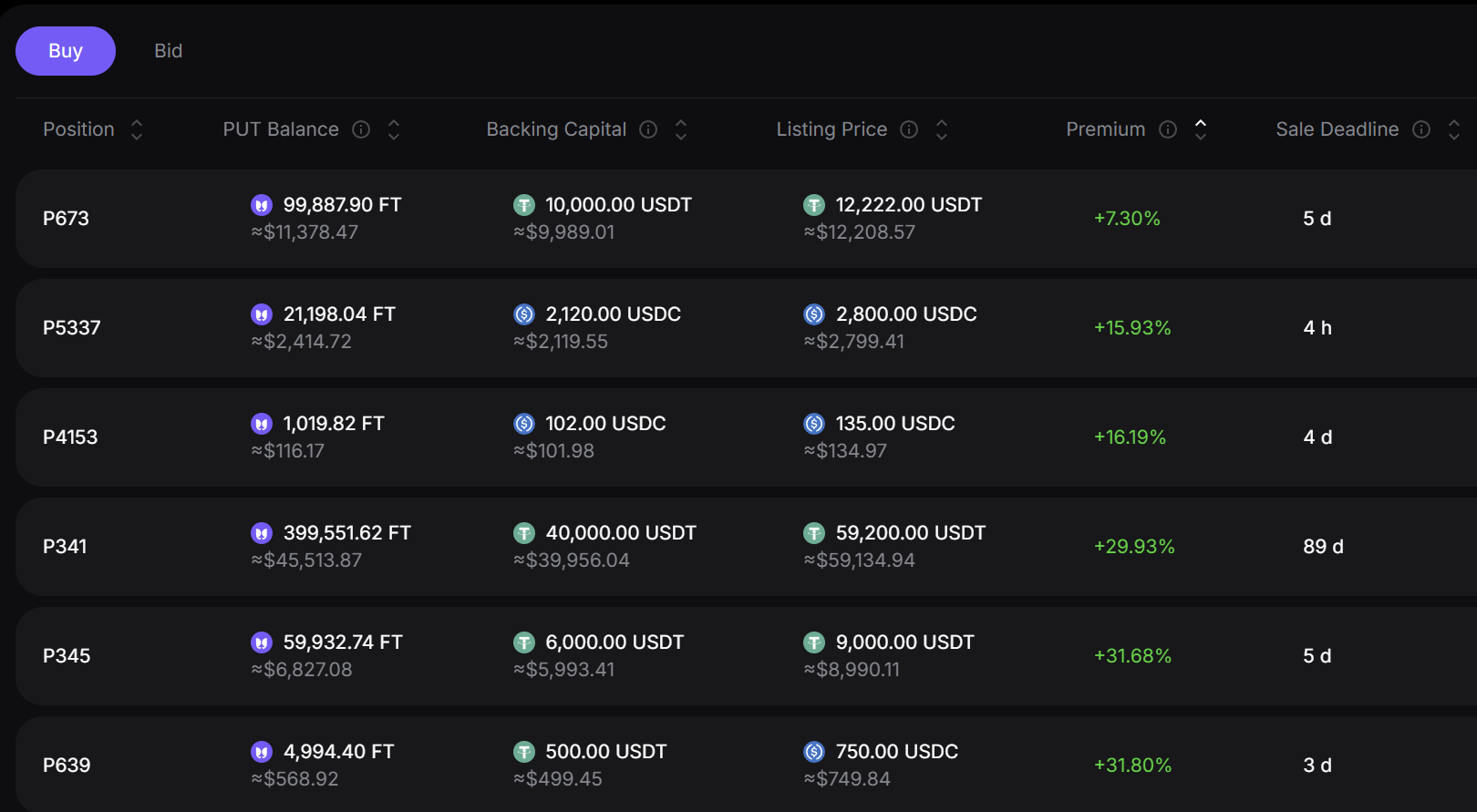
Holders can keep the protected position, redeem its backing capital, or withdraw FT and give up the corresponding protection. Because the position is held in an NFT, it can also be sold on Flying Tulip’s PUT Marketplace, transferring the remaining position and redemption rights to the buyer.
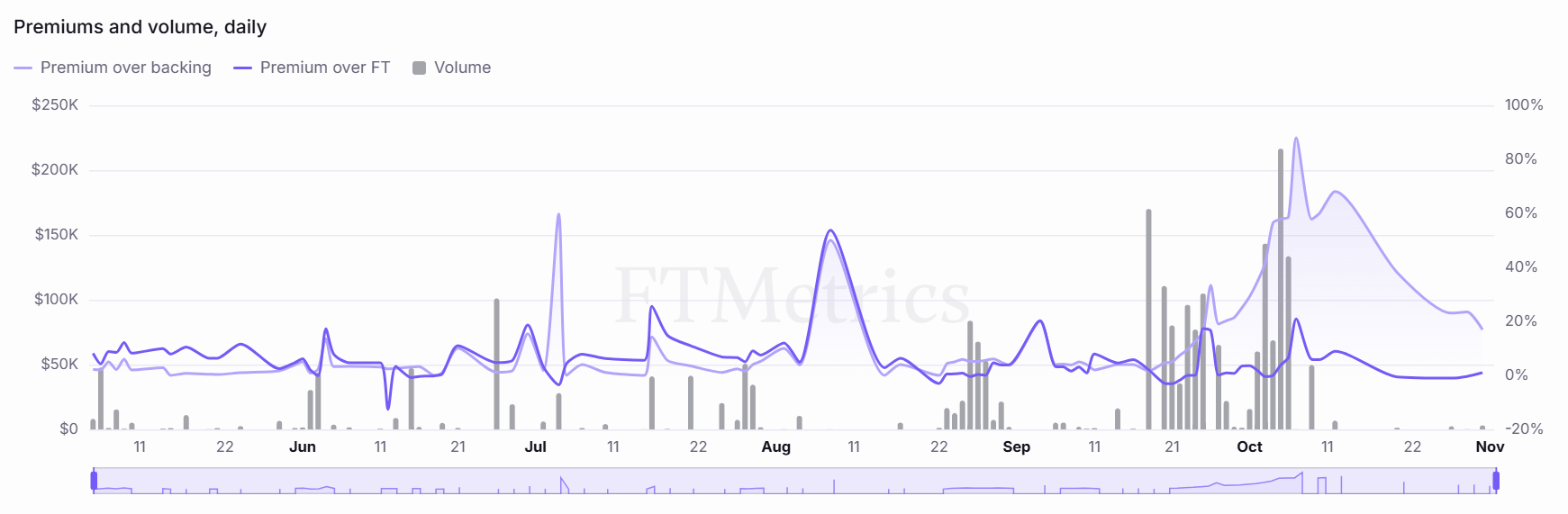
PUTs typically trade at a premium, with prices reflecting both the FT exposure and the protection attached to each position. Eligible Marketplace trading also carries a 10x Rewards points multiplier. October was the most active month for the PUT Marketplace, recording over $700,000 in volume.
A closer view through FTMetrics
Community-built FTMetrics brings PUT backing, exits, withdrawals and Marketplace trading into one dashboard. You can compare sale premiums over backing and liquid FT value, follow trading volume, and examine FT supply, liquidity, fees and buyback flows.
The PUT Explorer adds individual NFT histories and wallet positions. For a prospective Marketplace buyer, that provides a way to inspect a position’s backing and history alongside its asking price.
4. ftUSD: stability, yield and wider access
ftUSD is Flying Tulip’s dollar-pegged token and settlement asset, designed for stability first, with optional yield when you choose to stake it as sftUSD or ssftUSD.


ftUSD safety design combines conservative collateral pricing, hedged strategies, position limits and transparent onchain accounting. Minting and redemption provide arbitrage paths that help keep ftUSD near its dollar target.
— Anton Nell (@AntonNellCrypto) September 23, 2026
Anton explains how ftUSD works under the hood.
Hold, earn FT or compound ftUSD
ftUSD, sftUSD and ssftUSD give you three ways to use Flying Tulip’s dollar:
▸ ftUSD: hold, transfer, trade or use it as collateral. Holding it alone does not earn strategy yield.
▸ sftUSD: stake ftUSD 1:1 and receive yield separately as claimable FT. Unstaking returns 1 ftUSD per sftUSD.
▸ ssftUSD: automatically compound rewards into more ftUSD. As rewards accumulate, each ssftUSD becomes redeemable for more ftUSD.
You can mint ftUSD with supported stablecoins across three networks:
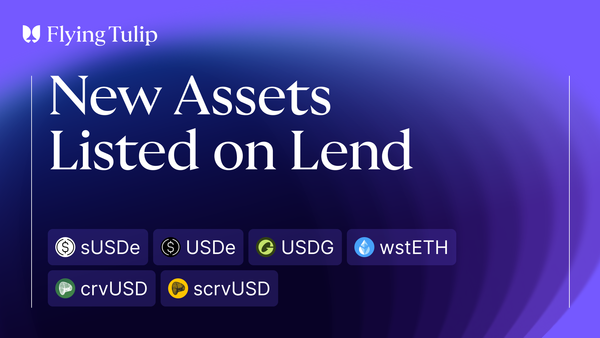
- Ethereum: USDC, USDT, USDe, USDG or crvUSD.
- Sonic: USDC.
- BNB Smart Chain: USDC or USDT.
Where the sftUSD and ssftUSD yield comes from
The backing capital earns through two connected sources:
- Lending: Stablecoins supplied to Lend earn interest from borrowers.
- Delta-neutral staking: Staking strategies generate additional income while hedging directional price exposure.
On Ethereum, the strategy borrows WETH against stablecoin collateral, converts it into wstETH and supplies that back to Lend. The staked asset earns ETH staking yield, while the WETH debt hedges ETH price exposure. The staking component’s return depends on the income earned after borrowing costs. Sonic and BNB Smart Chain follow the same principle with its native and staked-native assets.

The ftUSD Dashboard makes the backing, deployed strategies and yield breakdown available to inspect.
vaults.fyi
In October, our products were integrated into vaults.fyi, helping a broader base of users discover Flying Tulip and compare its yield opportunities.
Supply USDC, USDT, WETH, wstETH, WBTC or FT, or stake ftUSD into sftUSD directly through the app. You can also withdraw and track your positions, giving you another entry point into Flying Tulip’s lending and staking products.

Turtle
The Turtle integration brings ftUSD to Turtle’s network of liquidity providers.
Stake ftUSD on Ethereum through Turtle to receive sftUSD and earn yield distributed in FT purchased on the open market. Eligible deposits also earn Turtle Shells through the active rewards stream.


5. Lend: the shared account and credit layer
Lend is the collateral and credit layer behind Flying Tulip’s shared margin account. Deposits earn yield while providing borrowing power and collateral for Trade and TRS, and they remain available for account swaps.
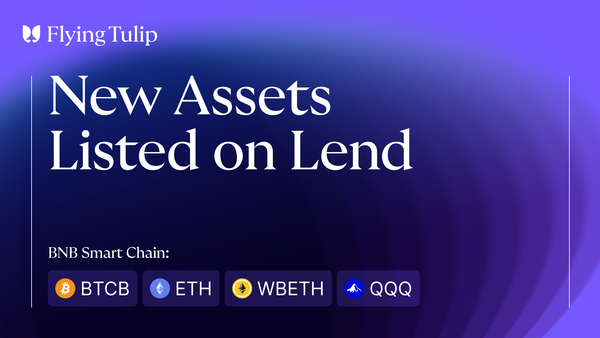
To support growing demand, Flying Tulip raised Lend caps across all three networks in October. On Ethereum, the FT supply cap increased to 4.75 million FT, the wstETH supply cap doubled to 1,000 wstETH, and the ftUSD supply cap rose to 2.50 million ftUSD. Borrowing caps also increased to 680 WETH and 900,000 ftUSD. On Sonic, the stS supply cap doubled to 40 million stS, while the asBNB supply cap on BNB Smart Chain doubled to 200 asBNB.
How account health determines borrowing power
Your account’s equity and maintenance requirement determine its health factor:
- Equity: eligible asset value − debt value + position P&L, floored at zero.
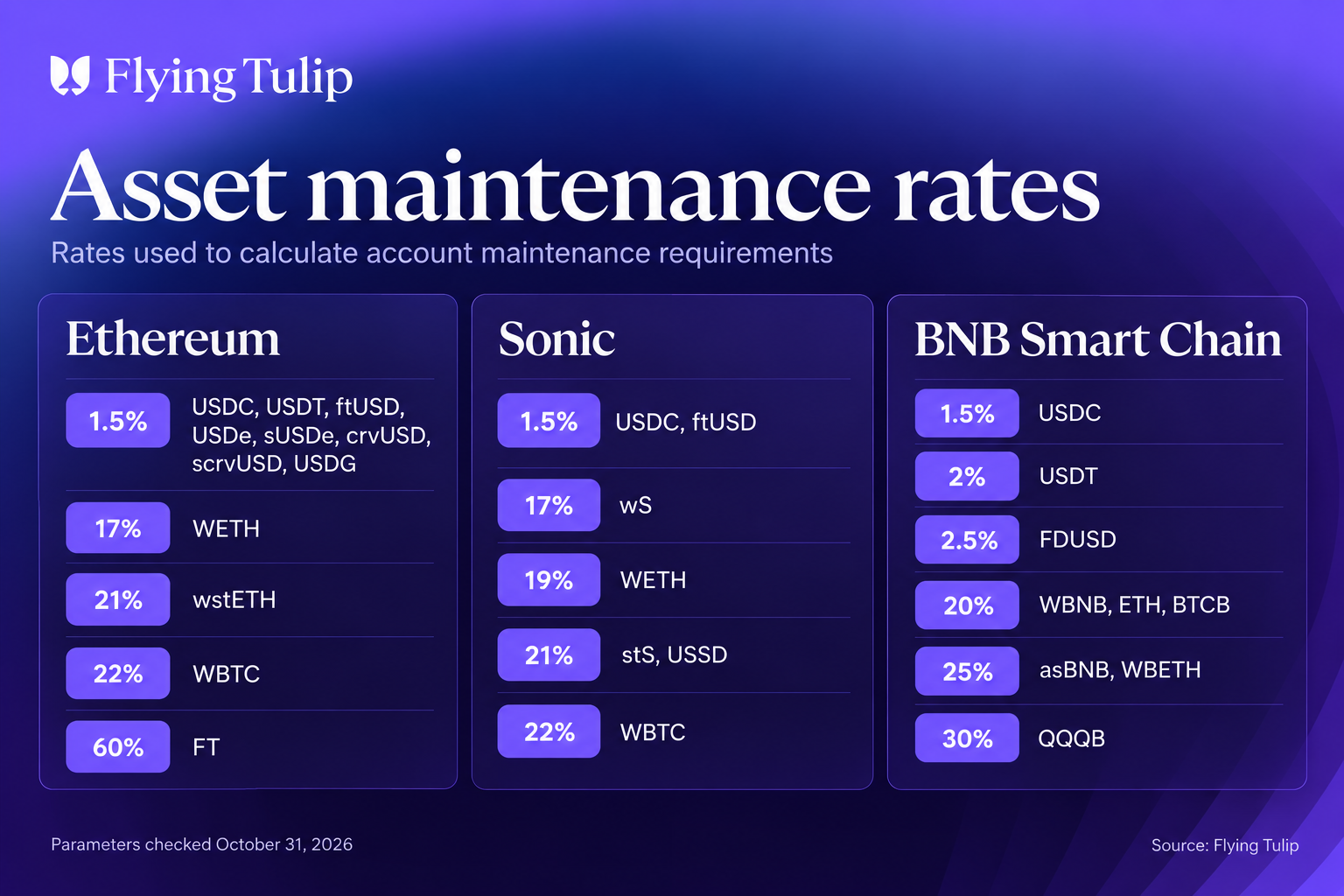
- Maintenance requirement: each collateral asset’s value multiplied by its maintenance rate, plus each debt asset’s value multiplied by its maintenance rate. Trading positions can add further position-specific requirements.
- Health factor: equity ÷ total maintenance requirement.
Maintenance margin is the risk requirement assigned to an asset. For example, WETH’s 17% rate means that $1,000 of WETH contributes $170 to the account’s maintenance requirement.
New borrowing and ordinary withdrawals must leave the health factor at or above 1.50 on all three chains. Equity must therefore cover at least 150% of calculated maintenance. The separate liquidation threshold is 1.25.
A borrowing example
Deposit $1,000 of WETH on Ethereum, then borrow and withdraw $500 of USDC from the account:
- Equity: $1,000 − $500 = $500
- Maintenance: 17% × $1,000 + 1.5% × $500 = $177.50
- Health factor: $500 ÷ $177.50 = 2.82
This example assumes unchanged prices and excludes fees and accrued interest. If borrowed funds remain in the account or acquire another eligible asset deposited back into it, that asset also enters the calculation.
6. Trade, TRS and Swap
Trade: trading engine and price source
Trade is Flying Tulip’s trading engine and price source. It uses request-for-quote (RFQ) execution to source quotes across all onchain liquidity, giving you access to venues beyond Flying Tulip’s own. The current release supports spot and leveraged spot trading, including market and limit orders for supported pairs.
Flying Tulip’s Trade and TRS use request-for-quote (RFQ) execution.
— flyingtulip.com (@flyingtulip_) October 14, 2026
Trades are not limited to Flying Tulip’s own liquidity. The system sources quotes across available onchain liquidity to find the best executable price for its users. pic.twitter.com/0aRfYrl1sg
For a leveraged long, the system borrows the funding asset, acquires the asset you want exposure to, and supplies the acquired asset back into the account as collateral.
Trade is live on Ethereum, Sonic and BNB Smart Chain, and it is more than a place to swap.
— flyingtulip.com (@flyingtulip_) October 14, 2026
It is Flying Tulip's trading engine and price source: the execution layer of a shared margin account that also lends, borrows, and settles.
A short thread on how it works. 🧵 pic.twitter.com/NEvyY9f7Rs
In addition to the AMM, a fully onchain CLOB (central limit order book) is currently being hardened. The AMM provides continuous liquidity, while the CLOB provides limit‑order precision. Once the CLOB launches, trades will clear on the AMM, through the CLOB, or across both; whichever produces the best executable price for the order size.
TRS
Total Return Swap provides long or short economic exposure to supported assets through the same account infrastructure.
It is widely used by hedge funds, credit funds and other institutions in traditional finance, with more than $3.3 trillion in equity TRS gross notional outstanding reported at the end of 2025.
Flying Tulip finally brings TRS onchain through its integrated stack:
— ftUSD provides settlement
— Lend provides financing
— Trade provides execution
The key difference from conventional perps is the financing model. TRS financing is based on collateral yield and the actual cost of borrowing the assets in Flying Tulip's Lend to construct the position.
TRS also has no orderbook fees. Execution uses RFQ across onchain liquidity to find the best price. The difference is similar to swapping through an aggregator instead of a single DEX pool.
All this makes TRS materially cheaper than a comparable perp.
Suppose you supply collateral to Lend and set a bid below the market price. Eligible collateral keeps earning while the order waits, even if the asset never reaches your target. After execution, you pay interest on borrowed ftUSD while earning lending yield on eligible collateral and the assets acquired for your leveraged exposure.
Total Return Swap (TRS) is now live on Flying Tulip, and it is more than another way to trade with leverage.
— flyingtulip.com (@flyingtulip_) September 4, 2026
TRS is an instrument institutions use to gain leveraged exposure to an asset without owning it, now built on the same infrastructure Flying Tulip already uses for… pic.twitter.com/OXV5uKJFjI
Since a TRS position is financed through Lend and executed through Trade, it does not rely on a matched opposing trader. Therefore, there is no auto-deleveraging: a profitable position is not reduced to absorb another trader’s losses. Your position must still meet margin requirements and can be liquidated if it does not.
In that case, Flying Tulip issues an RFQ and uses the best available bid to sell only what is needed to repay debt and restore account health, rather than automatically transferring collateral at a predetermined discount.
TRS also lets you hedge assets you already hold. You can retain a supported yield-bearing asset as collateral while taking offsetting short exposure, with borrowing costs and account-wide margin determining the economics of the hedge.
Flying Tulip’s Total Return Swap (TRS) has no auto-deleveraging (ADL). A profitable position isn’t forcibly reduced to cover another trader’s loss.
— flyingtulip.com (@flyingtulip_) October 29, 2026
Lend, Trade and TRS share the same margin account. Collateral keeps earning yield while an order waits. After execution, users pay… https://t.co/FtCowJxTcK
The new Swap
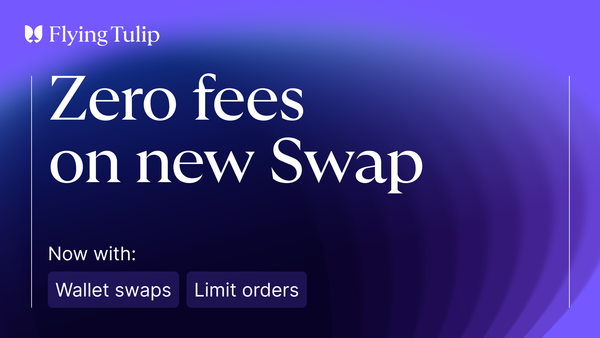
The new Swap launched in October, bringing wallet swaps and account swaps into one interface. Swap supported tokens directly from your wallet, or use assets already deposited in your Flying Tulip account. Account swaps let you change collateral without withdrawing it to your wallet first.
 Newton
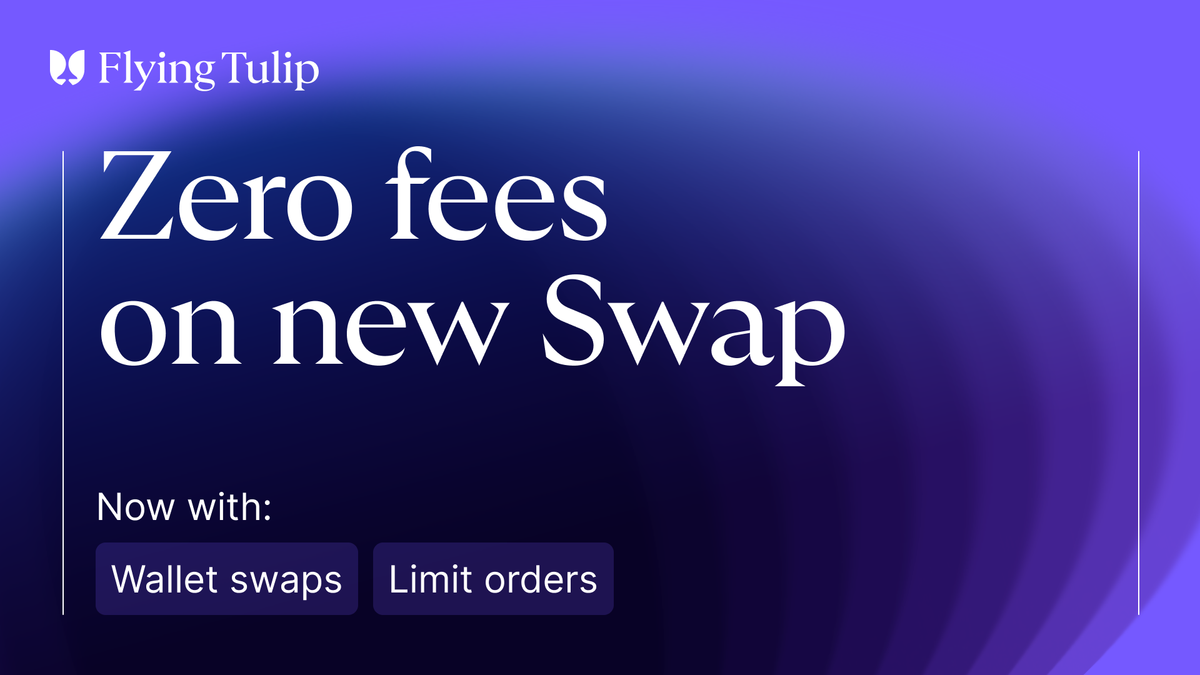
Market and limit orders are available for both balances. Set your tokens, amount, target price and expiration. With eligible assets supplied to Lend, your capital can keep earning while the order waits.
The Swap to earn yield option combines a swap with a deposit into Lend in one flow. The supported asset you receive can then earn yield and serve as collateral.
A new History page records your swap activity. Sessions also include a six-digit PIN for confirming actions. The PIN is never stored; forgetting it or entering it incorrectly three times requires creating a new session.
The new Flying Tulip Swap is live 🌷
— flyingtulip.com (@flyingtulip_) October 16, 2026
▸ Swap with no platform fee
▸ Swap from your wallet or your platform balance
▸ Set limit orders which earn while pending
▸ Swap to earn: swap and deposit to Lend in one go
▸ A new History page and six-digit session PIN
Full details in… pic.twitter.com/z4jD2GeZZQ
7. Rewards alongside product activity
Flying Tulip Rewards connects eligible user participation to protocol revenue.
Holding ftUSD or Perpetual PUTs, supplying or borrowing through Lend, trading through Trade or TRS, using the Marketplace, and providing eligible liquidity can accrue points. Opportunities include activity through Curve, Convex, Stake DAO and Morpho.
Eligible activity is tracked automatically, with multipliers determining how points accrue. The Rewards page brings the available activities together so you can inspect the opportunities and track participation.
The Rewards allocation is funded through 20% of revenue-funded FT buybacks. FT is purchased on the open market; the program does not depend on minting new tokens.
Flying Tulip Rewards are live, with 20% of FT supply going to users for eligible activity.
— flyingtulip.com (@flyingtulip_) October 8, 2026
Here is how it works 🧵 pic.twitter.com/kiIntxfWLe
If you made it this far, join the Flying Tulip community for the latest updates on Discord: https://discord.gg/flyingtulip, on Telegram: https://t.me/flyingtulipgroup, and follow the Telegram announcement channel: https://t.me/flyingtulipann.
Links
Socials
- Website: https://flyingtulip.com
- X/Twitter: https://x.com/flyingtulip_
- Discord: https://discord.gg/flyingtulip
- Telegram Chat: https://t.me/flyingtulipgroup
- Telegram Announcements: https://t.me/flyingtulipann
Products
- PUT Marketplace: https://marketplace.flyingtulip.com
- ftPUT: https://flyingtulip.com/allocation/dashboard
- ftUSD: https://flyingtulip.com/ftusd/dashboard
- Lend: https://flyingtulip.com/lend/dashboard
- Trade: https://flyingtulip.com/trade
- TRS: https://flyingtulip.com/trs
- Rewards: https://flyingtulip.com/rewards
Documentation
- FT Token: https://docs.flyingtulip.com/product-suite/ft-token
- ftUSD stablecoin: https://docs.flyingtulip.com/product-suite/ft-usd
- Roadmap: https://docs.flyingtulip.com/roadmap
- Contract addresses: https://docs.flyingtulip.com/contract-addresses
Official Dashboards
- PUT Options Overview https://flyingtulip.com/allocation/dashboard
- Lend Stats: https://flyingtulip.com/lend/dashboard
- ftUSD Stats and APY Breakdown: https://flyingtulip.com/ftusd/dashboard
- Protocol Fees and FT Supply: https://flyingtulip.com/statistics